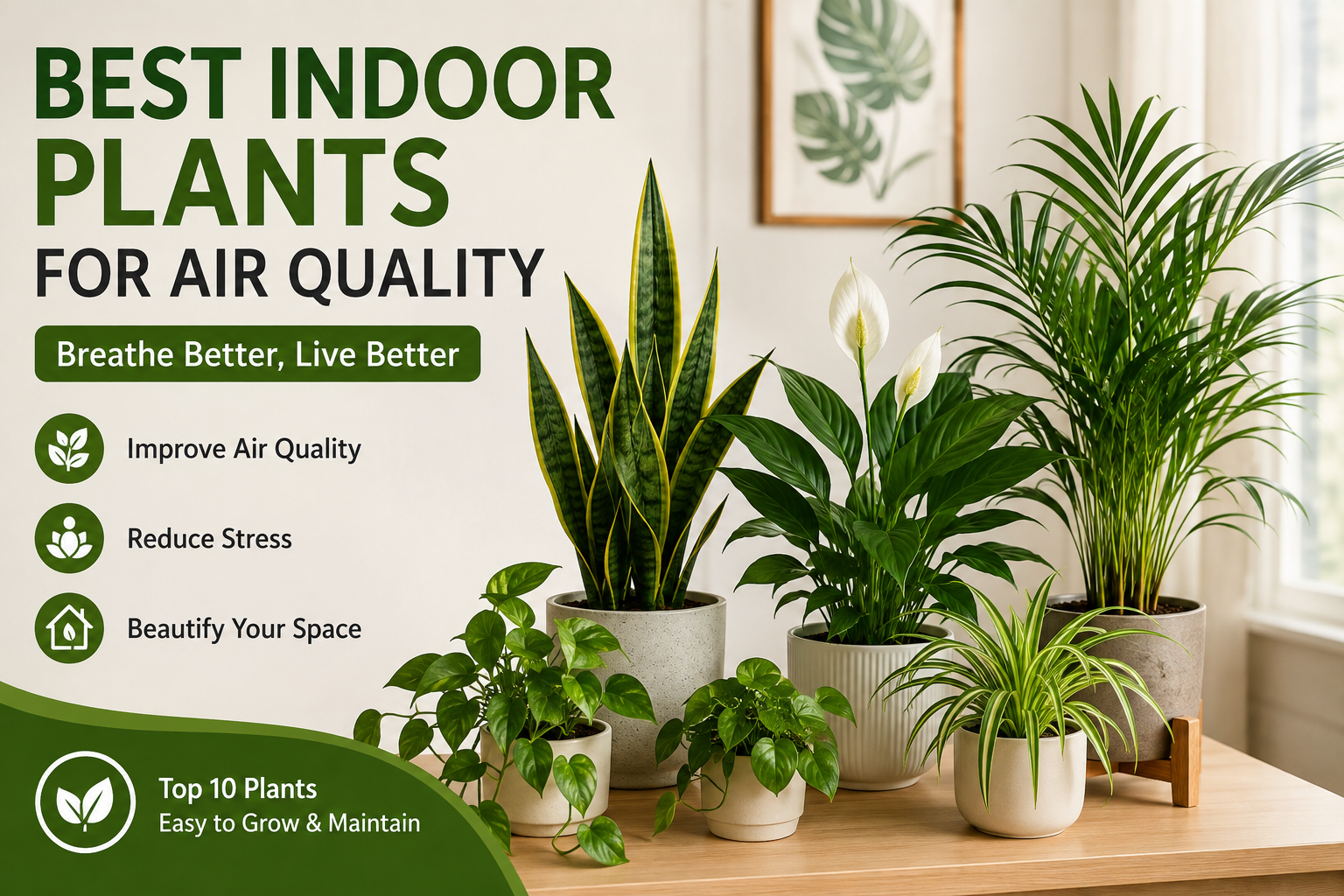
Indoor plants can make a room feel fresher, calmer, and more inviting. But when it comes to air quality, the reality is more nuanced than the popular claim that a few houseplants can “purify” an entire home.
Research has shown that certain plants can interact with some airborne pollutants under controlled laboratory conditions. However, a normal home is very different from a sealed research chamber. Ventilation, room size, pollution sources, humidity, and air exchange all affect indoor air quality.
So, what are the best indoor plants for air quality? The answer depends not only on the plant but also on your room, available light, maintenance routine, and whether you have pets.
This guide covers the top choices, what science actually says, where each plant works best, and how houseplants should fit into a broader indoor air-quality strategy.
Do Indoor Plants Really Improve Air Quality?
Plants naturally absorb carbon dioxide during photosynthesis and release oxygen. Some research has also demonstrated that certain plants and their associated growing media can remove or transform volatile organic compounds (VOCs) under controlled conditions.
VOCs can come from paints, furniture, cleaning products, adhesives, carpets, and other household materials. However, the ability of a plant to remove a pollutant in a laboratory does not necessarily mean that one plant will significantly lower pollutant concentrations in a typical bedroom or living room.
Houseplants can still be a useful part of a healthy indoor environment. They add greenery, can contribute modestly to humidity, and may support psychological well-being. Their air-cleaning role is best viewed as complementary rather than as a replacement for ventilation, source control, or appropriate filtration.
What Indoor Plants Cannot Replace
If your goal is to reduce dust, smoke particles, pollen, or pet dander, mechanical filtration can be much more effective than relying on plants.
Similarly, opening windows when outdoor conditions are appropriate, using kitchen and bathroom exhaust fans, controlling indoor pollution sources, and maintaining HVAC systems can have a much greater effect on overall indoor air quality.
What Did the NASA Clean Air Study Actually Find?
The NASA Clean Air Study is frequently cited in articles about air-purifying houseplants. The research examined whether certain plants could help remove pollutants from enclosed environments.
Plants including snake plants, spider plants, pothos, peace lilies, and other species became associated with indoor air purification because of this research.
The important detail is that the experiments were conducted under controlled conditions. A sealed or highly controlled chamber is not equivalent to a modern home where doors open, people move around, outdoor air enters, and HVAC systems continuously exchange or circulate air.
That does not make the research irrelevant. Instead, it means the findings should be interpreted carefully.
The NASA research helped demonstrate that plants can interact with certain pollutants. It did not establish that placing a handful of plants around a home can replace an air purifier or ventilation system.
Best Indoor Plants for Air Quality at a Glance
| Plant | Best For | Light | Care Level | Pet Consideration |
| Spider Plant | Beginners | Medium to bright indirect | Easy | Generally pet-friendly |
| Snake Plant | Low-light spaces | Low to medium | Very easy | Toxic if ingested |
| Areca Palm | Large rooms | Bright indirect | Moderate | Generally pet-friendly |
| Boston Fern | Humid rooms | Indirect | Moderate | Generally pet-friendly |
| Peace Lily | Bathrooms | Low to medium | Moderate | Toxic if ingested |
| Pothos | Apartments | Low to medium | Easy | Toxic if ingested |
| Dracaena | Offices | Medium | Easy to moderate | Toxic if ingested |
| Rubber Plant | Bright rooms | Bright indirect | Moderate | Toxic if ingested |
| Chinese Evergreen | Low-light rooms | Low to medium | Easy | Toxic if ingested |
| Aloe Vera | Sunny spaces | Bright | Easy | Can be harmful to pets |
10 Best Indoor Plants for Air Quality
1. Spider Plant
Spider plants are one of the easiest choices for beginners. Their long, arching leaves and small plantlets make them attractive in hanging baskets, on shelves, or near windows.
They prefer bright to moderate indirect light but can adapt to less ideal conditions. Water when the soil begins to dry, while avoiding consistently soggy roots.
Spider plants are also a particularly useful choice for households with pets because they are generally considered non-toxic to cats and dogs.
Best for: Beginners, apartments, shelves, and pet-friendly homes.
2. Snake Plant
The snake plant is famous for tolerating neglect. It can survive relatively low light and does not require frequent watering, making it ideal for busy homeowners.
Its upright leaves also take up little floor space. Place it in a bedroom, office, hallway, or apartment corner with indirect light.
Although snake plants are frequently promoted as air-purifying plants, they should not be treated as a substitute for ventilation or filtration. They are best appreciated as hardy, attractive houseplants with research-associated air-quality benefits.
Best for: Low-light rooms and people who prefer minimal maintenance.
3. Areca Palm
Areca palms bring a tropical appearance to living rooms and other larger spaces. They prefer bright, indirect light and consistent but not excessive moisture.
Because of their size and foliage, areca palms work especially well as statement plants. They are also generally considered pet-friendly.
They can contribute to indoor humidity, which may be useful in particularly dry environments, although excessive humidity can create its own problems.
Best for: Large living rooms and bright indoor spaces.
4. Boston Fern
Boston ferns are attractive, lush plants that prefer humidity and indirect light. This makes them particularly suitable for rooms where moisture levels are naturally higher.
They require more consistent care than snake plants or pothos. Their soil should not be allowed to become completely dry for extended periods.
A bathroom with sufficient natural light can be a good location, but poor ventilation and excessive moisture should be avoided.
Best for: Humid rooms and plant owners willing to provide regular care.
5. Peace Lily
Peace lilies are popular because their dark green leaves and white flowers provide a polished indoor appearance. They can tolerate lower light than many flowering plants and generally appreciate moderate humidity.
However, peace lilies are not a good choice for households where pets frequently chew on plants. They contain compounds that can cause irritation if ingested.
Best for: Bathrooms, low-to-medium-light areas, and people who want flowers.
6. Pothos
Pothos is one of the most adaptable indoor plants. Its trailing vines work well in hanging planters, offices, bookshelves, and apartments.
It tolerates a range of lighting conditions and usually recovers well if watering is occasionally missed. However, it should not be considered pet-safe because ingestion can cause problems.
Best for: Apartments, home offices, and beginners without plant-chewing pets.
7. Dracaena
Dracaena includes several popular indoor varieties with tall growth and attractive foliage. They can work well as floor plants in offices, living rooms, and entryways.
Most varieties prefer indirect light and should not be kept in constantly wet soil. Their larger size can also make them useful when you want greenery without filling a room with numerous small pots.
Dracaenas are not considered safe for cats and dogs if eaten, so placement matters in pet households.
Best for: Offices and larger indoor spaces.
8. Rubber Plant
Rubber plants are excellent choices for bright rooms where you want a substantial decorative plant. Their large leaves create a strong visual impact and can make an otherwise plain corner feel more finished.
They generally prefer bright indirect light and well-draining soil. Allow the soil to dry somewhat between waterings rather than keeping it continuously wet.
Best for: Bright living rooms and spacious interiors.
9. Chinese Evergreen
Chinese evergreen varieties are valued for their attractive foliage and ability to tolerate relatively low indoor light.
They can be a practical option for apartments and rooms without direct sunlight. Watering should be moderate, with good drainage to prevent root problems.
Because some varieties can be harmful if ingested, households with pets should choose placement carefully.
Best for: Low-light apartments and beginner plant owners.
10. Aloe Vera
Aloe vera is particularly suitable for sunny rooms. Unlike moisture-loving plants, aloe prefers well-draining soil and should not be watered too frequently.
A sunny kitchen windowsill or bright room can provide the conditions it needs. Its compact shape also makes it easier to fit into smaller spaces.
Aloe vera should be kept away from pets that may chew on it.
Best for: Sunny windowsills and compact spaces.
Which Plant Is Best for Your Room?
The “best” plant is ultimately the one that matches your environment.
For low-light rooms, snake plants, pothos, and Chinese evergreen are practical choices.
For bright rooms, consider aloe vera, rubber plants, or areca palms.
For small apartments, spider plants, snake plants, and pothos can provide greenery without consuming much floor space.
For large rooms, areca palms, rubber plants, and dracaenas can create more visual impact.
If you have cats or dogs, prioritize species known to be pet-friendly rather than choosing a plant solely because it appears on an air-cleaning list.
Best Indoor Plants for Air Quality by Room
Bedroom
Snake plants and spider plants are popular bedroom choices because they are relatively easy to maintain and don’t require constant attention.
However, don’t assume that putting several plants beside your bed will dramatically improve nighttime oxygen levels or replace normal ventilation.
Bathroom
Boston ferns, peace lilies, and some palms can work well in bathrooms because they appreciate humidity.
Light remains important. A dark bathroom without a window may not provide enough natural light for long-term plant health.
Kitchen
Spider plants and aloe vera can work well in kitchens. Pothos can also be useful where there is sufficient indirect light.
Keep plants away from direct heat sources, stovetops, and areas where grease accumulates heavily on leaves.
Home Office
Pothos, snake plants, and dracaenas are practical office choices because they are generally easy to maintain.
If your concern is dust, allergens, or fine particles while working, however, an appropriate air purifier and regular cleaning will generally be more useful than adding more plants.
Are Indoor Plants Better Than an Air Purifier?
Houseplants and air purifiers serve different purposes.
| Feature | Houseplants | HEPA Air Purifier | Ventilation |
| Decorative value | High | Low | None |
| Particle filtration | Limited | High | Variable |
| VOC management | Potentially limited | Depends on filter | Often useful |
| Humidity effect | Can increase | Usually minimal | Variable |
| Maintenance | Watering and care | Filter replacement | System maintenance |
| Best role | Complementary | Filtration | Fresh-air exchange |
If your primary concern is airborne particles such as dust, pollen, smoke, or pet dander, a properly selected HEPA purifier can be much more appropriate.
Plants can complement these strategies rather than replace them.
How Many Plants Do You Need?
There is no universally proven number of houseplants that will make a typical home’s air “clean.”
Plant size, leaf area, room volume, air exchange, pollutant sources, and ventilation all matter. A formula based solely on the number of plants per square foot can create unrealistic expectations.
Instead of buying plants purely for a target number, select healthy plants that fit your space and care routine.
A home with good ventilation, controlled pollution sources, appropriate humidity, and suitable filtration is likely to have a better indoor environment than a poorly ventilated room filled with plants.
Can Too Many Plants Make Indoor Air Quality Worse?
More plants are not automatically better.
Overwatering can leave potting soil continuously damp. Poor drainage can encourage root problems, while persistently wet organic material may contribute to unwanted microbial growth and attract fungus gnats.
Excessive plant density can also raise indoor humidity, which may be undesirable in an already humid environment.
The solution is simple: use pots with drainage holes, avoid unnecessary watering, remove dead foliage, and monitor humidity when you have many plants.
How to Care for Indoor Plants Properly
Healthy plants require the right environment.
First, understand the light requirements of each species. A low-light plant placed in harsh direct sunlight can suffer, while a sun-loving plant may struggle in a dark corner.
Second, avoid overwatering. Check the soil before adding more water, and make sure excess water can drain away.
Finally, keep leaves reasonably clean and remove damaged foliage. Good plant care supports healthy growth, but cleaning leaves should not be presented as a major substitute for actual air filtration.
Common Mistakes to Avoid
One of the biggest mistakes is assuming that a plant studied in a laboratory automatically provides powerful air purification in a home.
Another is ignoring pet safety. Some of the most frequently recommended houseplants can be harmful to cats and dogs if eaten.
Other mistakes include choosing plants without considering light, overwatering, placing too many plants in a poorly ventilated room, and expecting houseplants to remove smoke, dust, or allergens as efficiently as mechanical filtration.
The smartest approach is to treat plants as one part of a broader healthy-home strategy.
Conclusion
The best indoor plants for air quality are not necessarily the plants with the biggest air-purification claims. The better choice is a healthy plant that fits your room, lighting, maintenance routine, and household safety needs.
Spider plants, snake plants, palms, ferns, pothos, dracaenas, rubber plants, Chinese evergreen, peace lilies, and aloe vera can all bring meaningful practical and decorative benefits to an indoor space.
Just keep the science in perspective. Houseplants can complement a healthy home, but they should not replace ventilation, pollution-source control, proper humidity management, or effective air filtration when those measures are needed.
FAQs About the Best Indoor Plants for Air Quality
What is the best indoor plant for air quality?
There is no single best plant for every home. Spider plants, snake plants, areca palms, pothos, and other popular houseplants have been associated with air-quality research, but the best choice depends on light, maintenance, room size, and pet safety.
Do indoor plants actually clean the air?
Some plants have demonstrated the ability to interact with certain pollutants under controlled conditions. However, their effect in an ordinary home is likely much more limited than laboratory results may suggest. Plants should complement, not replace, ventilation and filtration.
Which indoor plant is best for low light?
Snake plants, pothos, and Chinese evergreen are among the more adaptable choices for low-light indoor environments. Even low-light plants still need some usable light to remain healthy.
Are air-purifying plants safe for cats and dogs?
Not all of them. Spider plants, areca palms, and Boston ferns are generally considered pet-friendly, while plants such as pothos, peace lilies, snake plants, and dracaenas can be problematic if ingested.
How many plants do I need to improve indoor air quality?
There is no reliable universal number for a normal home. Plant size, room volume, ventilation, and pollutant sources all influence the result. Choose plants based on your environment rather than a fixed plant-per-room formula.
Are plants better than air purifiers?
No. They perform different roles. A suitable HEPA purifier is designed to capture airborne particles, while plants primarily provide greenery and may have limited pollutant-removal effects under certain conditions.
Can indoor plants remove dust and allergens?
Plants should not be relied upon to remove significant amounts of dust, pollen, smoke, or pet dander. Regular cleaning, source control, ventilation, and appropriate filtration are more dependable strategies for these pollutants.