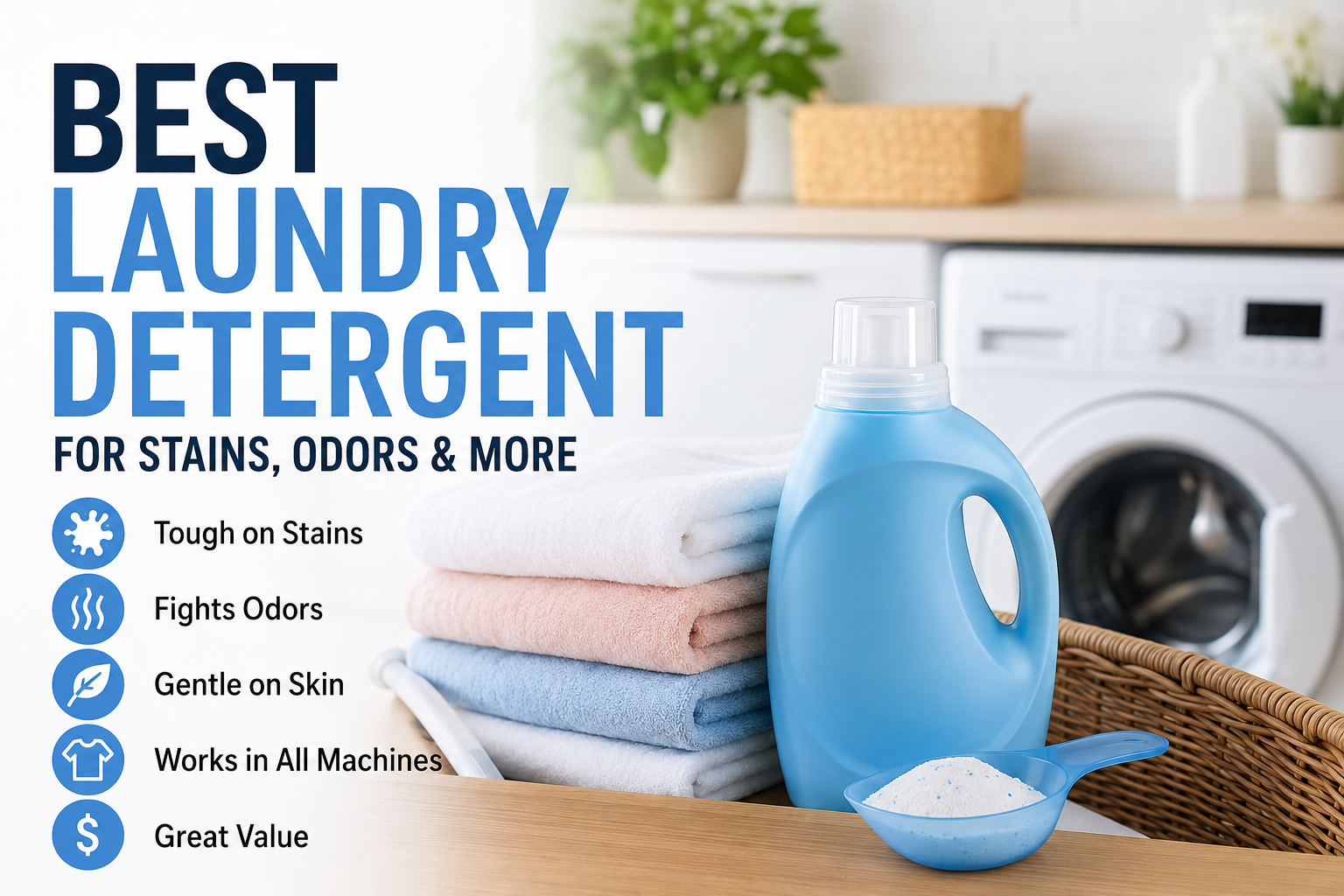
Choosing the best laundry detergent is not simply about picking the most popular bottle on the shelf. The right detergent depends on what you wash, the types of stains you deal with, your washing machine, water hardness, skin preferences, and how much you want to spend per load.
A detergent that works brilliantly on greasy work clothes may not be the best choice for sensitive skin. Likewise, a heavily scented formula may appeal to some households but be unsuitable for people who prefer fragrance-free laundry.
The best approach is to compare cleaning performance, stain removal, ingredients, value, convenience, and compatibility with your laundry routine. This guide explains what to look for and how to choose a detergent that fits your specific needs.
What Is the Best Laundry Detergent?
There is no single laundry detergent that is perfect for every household. The best laundry detergent is the one that provides the right balance of cleaning power, fabric care, convenience, price, and personal preferences.
For everyday laundry, look for a detergent that can handle body oils, dirt, food stains, and normal odors without leaving excessive residue. For specialized needs, choose a formula designed around the problem you encounter most often.
| Laundry Need | What to Look For | Why It Matters |
| Everyday laundry | Balanced cleaning formula | Handles routine dirt and stains |
| Tough stains | Enzymes and effective surfactants | Helps break down food, grease, and biological stains |
| Sensitive skin | Fragrance- and dye-free options | Reduces exposure to common irritants |
| Odor removal | Strong cleaning and odor control | Removes rather than simply masks odors |
| Budget washing | Low cost per load | Provides better long-term value |
| Eco-conscious laundry | Concentrated formulas and credible certifications | Can reduce packaging and environmental impact |
| Hard water | Formula suited to mineral-rich water | Helps maintain cleaning performance |
How to Evaluate the Best Laundry Detergent
A useful detergent comparison should go beyond brand popularity. Several factors determine whether a formula is genuinely useful.
Cleaning Performance
A good detergent should remove everyday dirt, body oils, food residue, and grime without requiring excessive product.
Cleaning performance also depends on water temperature, load size, washer type, and how heavily soiled the clothing is.
Stain Removal
Different stains require different cleaning approaches. Enzymes such as protease, amylase, and lipase can help target protein, starch, and oily stains.
For example, grass and food stains may benefit from enzyme-based cleaning, while greasy clothing may require strong surfactant performance and appropriate pretreatment.
Odor Control
A strong fragrance does not necessarily mean better cleaning. Some detergents mainly make clothes smell fresh, while effective cleaning helps remove the residues responsible for unpleasant odors.
This distinction is particularly important for workout clothes, towels, socks, and pet bedding.
Cost Per Load
Compare detergent based on cost per load, rather than the sticker price of the container.
A larger bottle may seem expensive but could provide significantly more washes. Concentrated detergent can also change the amount needed for each load.
Ingredients and Skin Considerations
People with fragrance preferences or sensitive skin may want to look for fragrance-free and dye-free formulas. Ingredient transparency can also make it easier to decide whether a product fits your household.
Remember that “plant-based” does not automatically mean that a product is suitable for everyone. Individual sensitivities vary.
Best Laundry Detergent for Different Needs
Best Laundry Detergent for Everyday Washing
For regular household laundry, choose a versatile detergent that works across common fabrics and soil levels.
A balanced formula should handle shirts, jeans, towels, bedding, socks, and everyday clothing without requiring multiple products.
Best for: Households that want one dependable detergent for most loads.
Best Laundry Detergent for Tough Stains
If your laundry regularly contains grease, grass, food, sweat, or makeup stains, prioritize stain-fighting performance.
Look for formulas containing enzymes and effective surfactants. For particularly stubborn stains, pretreating the area before washing can improve results.
Practical example: A shirt with a fresh tomato sauce stain may respond better to pretreatment followed by a normal wash than simply adding extra detergent to the machine.
Best Laundry Detergent for Sensitive Skin
Sensitive-skin laundry generally calls for a simpler approach. Consider fragrance-free and dye-free formulas and avoid using more detergent than recommended.
Extra detergent can remain in fabric if the washing process does not remove it completely.
Best for: People who prefer minimal fragrance or want a simpler laundry routine.
Best Fragrance-Free Laundry Detergent
“Fragrance-free” and “unscented” are not always interchangeable terms. Fragrance-free generally means fragrance ingredients have not been added, while unscented products may use ingredients intended to neutralize or mask odors.
Read the product label carefully rather than relying only on front-of-package marketing.
Best Laundry Detergent for Odors
For persistent sweat or musty smells, focus on cleaning performance rather than fragrance intensity.
Workout clothing, towels, and synthetic fabrics can hold onto odor-causing residues. Washing according to the fabric-care instructions and avoiding overloaded machines can help detergent work more effectively.
Best Budget Laundry Detergent
Budget-conscious shoppers should calculate the approximate cost per load.
Also consider dosage. A low-priced detergent that requires a large amount per wash may not provide better value than a concentrated formula with a higher initial price.
Best Eco-Friendly Laundry Detergent
Eco-conscious shoppers should look beyond labels such as “green” or “natural.”
Consider:
- Concentrated formulas
- Plant-based ingredients
- Packaging materials
- Reduced plastic use
- Refill systems
- Detergent sheets
- Recognized environmental certifications
The most sustainable option also depends on how much product is used and how frequently you wash.
Liquid vs. Powder vs. Pods vs. Laundry Sheets
The detergent format can be just as important as the formula.
| Detergent Type | Advantages | Potential Drawbacks | Best For |
| Liquid | Flexible dosing and useful for pretreatment | Can spill or be overused | General laundry |
| Powder | Often economical and useful for certain heavy loads | May not dissolve as well in some conditions | Regular or heavily soiled laundry |
| Pods | Convenient, premeasured | Less control over dosage | Busy households |
| Sheets | Lightweight and convenient | Performance varies by product | Convenience-focused users |
Is Liquid or Powder Better?
Neither is universally better. Liquid offers flexible dosing and can be useful for pretreating stains. Powder can be economical and may work particularly well for certain laundry routines.
Your water temperature and washer instructions should also influence the decision.
Are Laundry Pods Worth It?
Pods are convenient because the detergent is premeasured. They can be useful for households that want to simplify laundry.
The trade-off is reduced dosing flexibility. A fixed amount may not be ideal for every load size or soil level.
Are Laundry Detergent Sheets Effective?
Laundry sheets are designed for convenience and easy storage. They are lightweight and can reduce the need for bulky detergent containers.
However, performance varies by formula, so shoppers should evaluate actual cleaning performance rather than assuming all sheets work equally well.
What Ingredients Should You Look For?
Understanding basic detergent ingredients can make product labels much easier to interpret.
Surfactants
Surfactants help loosen oils and dirt from fabric so they can be suspended in water and rinsed away.
Enzymes
Different enzymes target different types of stains.
Protease helps break down protein-based stains. Amylase targets starch-based residues, while lipase can help with oily or greasy stains.
Builders
Builders support cleaning performance by helping manage minerals in the wash water and improving the effectiveness of other detergent ingredients.
Fragrance and Dyes
These ingredients primarily affect the sensory experience of laundry rather than determining cleaning performance.
People who prefer fragrance-free products may want to avoid added fragrance.
How to Choose the Right Laundry Detergent
Choosing the best laundry detergent becomes easier when you start with your actual laundry needs.
Step 1: Identify Your Biggest Problem
Do you struggle with stains, odors, sensitive skin, cost, or environmental concerns?
Step 2: Consider Your Washer
Check whether your machine is a high-efficiency (HE) washer and follow the washer manufacturer’s detergent recommendations.
Step 3: Think About Water Hardness
Hard water contains higher levels of minerals that can interfere with cleaning. If clothing feels stiff or detergent seems less effective, water hardness may be one factor worth investigating.
Step 4: Compare Cost Per Load
Don’t judge value by bottle size alone. Check the recommended dosage and number of loads.
Step 5: Read the Label
Look for information about fragrance, dyes, enzymes, certifications, washer compatibility, and recommended dosage.
Best Detergent for Different Laundry Types
Different fabrics and laundry categories can have different needs.
Baby Clothes
A fragrance-free or dye-free option may be preferred by households trying to minimize unnecessary additives. Always follow clothing-care instructions.
Workout Clothes
Focus on effective odor and residue removal. Avoid overloading the washer, particularly with synthetic athletic clothing.
Towels
Towels can develop persistent odors when moisture remains trapped in fabric. Proper washing, thorough drying, and appropriate detergent dosage are important.
Bedding
Sheets and bedding accumulate sweat, body oils, and skin debris. Use the detergent amount recommended for the load size rather than automatically adding extra detergent.
White Clothes
White laundry may benefit from formulas or washing routines designed to address stains and maintain brightness. Avoid assuming that more detergent will automatically produce whiter clothing.
Does Water Hardness Affect Laundry Detergent?
Yes, water hardness can influence cleaning performance.
Hard water contains minerals such as calcium and magnesium. These minerals can interact with cleaning ingredients and make it more difficult for detergent to perform efficiently.
Signs that water hardness may be affecting laundry include:
- Clothing feels stiff after washing
- Fabrics look dull
- Mineral deposits appear around fixtures
- Detergent seems less effective than expected
If you suspect hard water, check your local water information or use an appropriate water-hardness test rather than simply increasing detergent dosage.
How Much Laundry Detergent Should You Use?
Using more detergent is not necessarily better.
Follow the detergent manufacturer’s dosing instructions and consider:
- Load size
- Soil level
- Detergent concentration
- Washer type
- Water conditions
Too much detergent can contribute to residue and may make rinsing more difficult.
For pods, follow the package instructions instead of cutting or opening them. For liquid and powder detergents, use the provided measuring guidance.
HE vs. Regular Washing Machines
HE washing machines use less water than traditional machines, so they generally require detergents designed for low-water washing conditions.
Always check the detergent label for HE compatibility and follow your washer manufacturer’s instructions.
Using the wrong detergent or excessive detergent can contribute to excess suds and residue.
Cold Water vs. Hot Water
Modern detergents can work effectively in cold-water cycles, but temperature still matters for certain laundry situations.
Cold water can be useful for everyday clothing and may help reduce energy use. Warmer water can sometimes be useful for heavily soiled items when the fabric-care label permits it.
The detergent formula, stain type, fabric, and washing instructions should all be considered together.
Common Laundry Detergent Mistakes
Using Too Much Detergent
Extra detergent doesn’t automatically mean cleaner clothes. Follow the recommended dosage.
Choosing Detergent Only for Its Scent
A strong fragrance is not a substitute for effective cleaning.
Ignoring Water Hardness
If your detergent suddenly seems ineffective, water conditions may be one factor worth considering.
Overloading the Washing Machine
Clothes need enough room to move through water and detergent. An overloaded drum can reduce cleaning performance.
Assuming All Detergents Work the Same
Different formulas are designed around different priorities. A sensitive-skin detergent may prioritize simplicity, while a heavy-duty formula may focus more strongly on stain removal.
Laundry Detergent Buying Checklist
Before buying the best laundry detergent for your household, ask:
- Does it address my biggest laundry problem?
- Is it compatible with my washer?
- Is the fragrance appropriate for my preferences?
- Does the formula contain ingredients suited to my typical stains?
- What is the cost per load?
- Does it perform well in my preferred water temperature?
- Do I need liquid, powder, pods, or sheets?
- Does the brand provide clear ingredient information?
- Are environmental claims supported by credible certifications?
Conclusion
The best laundry detergent is not necessarily the most expensive, most popular, or most heavily advertised option. It is the detergent that matches your clothes, stains, washer, water conditions, skin preferences, and budget.
For everyday laundry, prioritize balanced cleaning performance and value. For tough stains, look for effective stain-fighting ingredients. For sensitive skin, consider fragrance-free and dye-free options. And if sustainability matters, evaluate ingredients, packaging, concentration, and credible certifications together.
Most importantly, use the correct amount of detergent and avoid assuming that more product equals cleaner clothes. A thoughtful choice and proper washing routine can make a bigger difference than simply buying the biggest bottle on the shelf.
Frequently Asked Questions
What is the best laundry detergent overall?
The best option depends on your priorities. For everyday laundry, choose a balanced formula with reliable cleaning performance, appropriate washer compatibility, and reasonable cost per load.
What laundry detergent is best for tough stains?
Look for a detergent with effective surfactants and enzymes that target common stain types. Pretreating stubborn stains can also improve results.
Is liquid, powder, or pod detergent better?
There is no universal winner. Liquid provides flexible dosing, powder can offer good value, pods maximize convenience, and sheets prioritize portability and easy storage.
What is the best laundry detergent for sensitive skin?
Many shoppers prefer fragrance-free and dye-free formulas. Read the ingredient information carefully and follow recommended dosage to minimize residue.
Does expensive laundry detergent clean better?
Not necessarily. Price does not automatically indicate cleaning performance. Compare stain removal, ingredients, dosage, number of loads, and cost per load.
How much laundry detergent should you use?
Follow the manufacturer’s recommended amount based on load size and soil level. Concentrated detergents may require significantly less product than traditional formulas.
Does laundry detergent work in cold water?
Many modern detergents are formulated to work in cold water. However, performance can vary by formula and stain type, so always consider the detergent instructions and fabric-care label.