
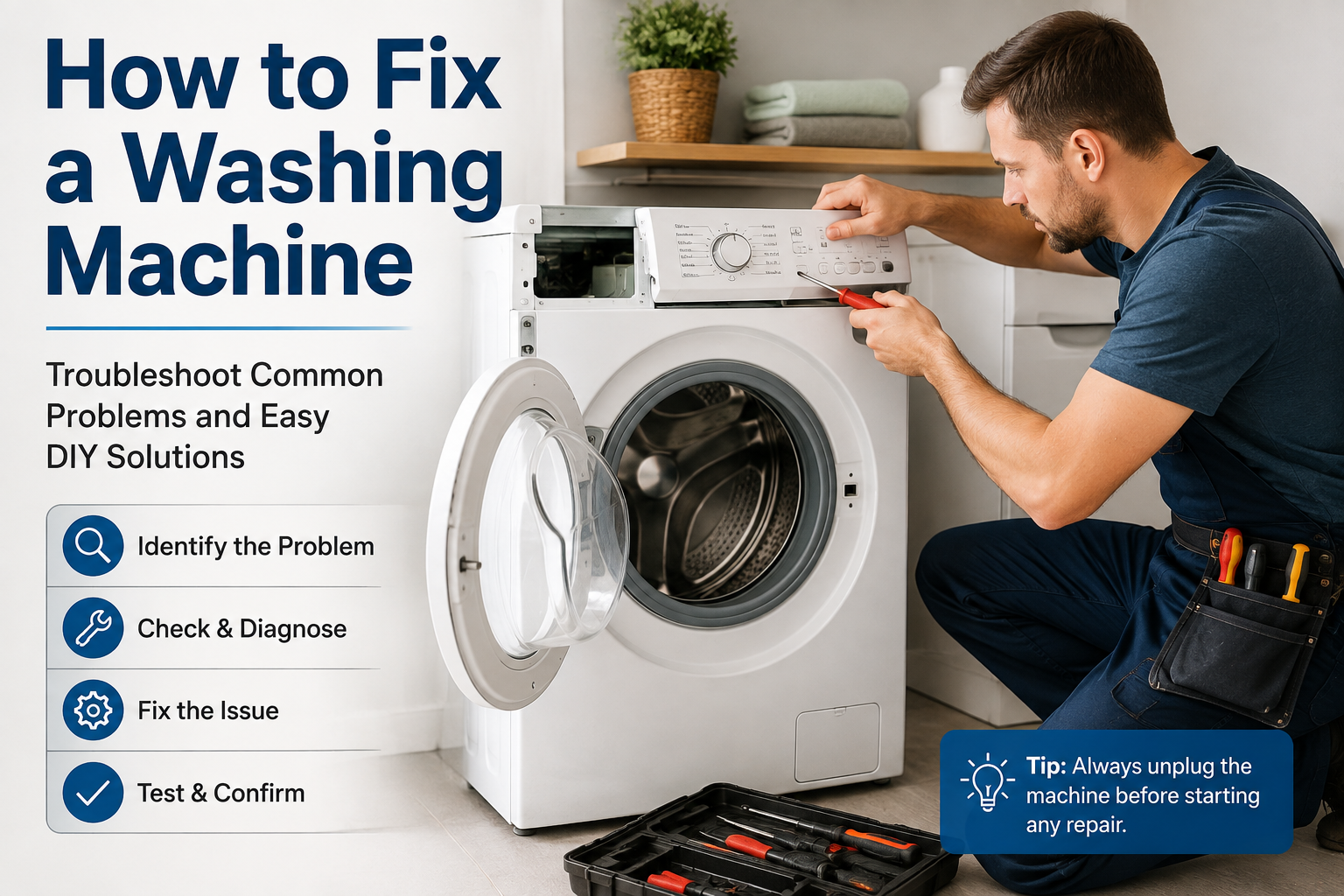
A washing machine that suddenly stops working can turn a simple laundry day into a frustrating problem. The good news is that many common washer issues have simple causes, such as an unbalanced load, blocked drain hose, closed water valve, excessive detergent, or an improperly leveled appliance.
Before assuming that a major component has failed, start with basic troubleshooting. Knowing how to fix washing machine problems safely can help you identify the cause, handle simple repairs yourself, and recognize when professional service is the better choice.
This guide covers the most common washing machine problems, practical fixes, safety precautions, and maintenance tips to help keep your appliance working reliably.
Before You Try to Fix Your Washing Machine
Safety should come before troubleshooting.
Unplug the washing machine before inspecting components, removing panels, or working near electrical connections. If you’re dealing with a leak or water supply problem, turn off the appropriate water valves as well.
Keep these basic precautions in mind:
- Never work on a powered appliance.
- Don’t bypass a door or lid safety switch.
- Don’t reach into a moving drum.
- Be careful when draining standing water.
- Don’t attempt electrical repairs unless you’re qualified.
- Check your owner’s manual before removing parts or following model-specific procedures.
A flashlight, towels, bucket, gloves, and basic screwdrivers are useful for simple inspections.
Quick Washing Machine Troubleshooting Checklist
| Problem | Common Cause | First Thing to Check | DIY Level |
| Won’t turn on | Power or door issue | Outlet and breaker | Easy |
| Won’t fill | Water supply problem | Valves and hoses | Easy |
| Won’t drain | Blockage or pump issue | Drain hose/filter | Easy-Moderate |
| Won’t spin | Unbalanced load | Load and drainage | Easy |
| Leaking | Hose or seal problem | Leak location | Easy-Moderate |
| Shaking | Uneven load or floor | Washer level | Easy |
| Loud noises | Object or mechanical issue | Drum and load | Easy-Professional |
| Bad smell | Residue or mildew | Gasket and drum | Easy |
Start with the simplest possible explanation before assuming an expensive component has failed.
How to Fix a Washing Machine That Won’t Turn On
If nothing happens when you press the power button, begin with the electrical supply.
Check the outlet and circuit breaker
Make sure the washer is firmly plugged into the outlet. Test the outlet with another appropriate appliance if necessary. Then check your home’s circuit breaker.
If the breaker repeatedly trips when the washer is used, don’t keep resetting it. A recurring electrical problem should be professionally diagnosed.
Check the door or lid
Many washers won’t begin a cycle unless the door or lid is completely closed. Look for clothing caught around the seal and make sure nothing prevents the latch from engaging.
Check the controls
Make sure a cycle has actually been selected and that control lock or child-lock settings haven’t been activated.
If the machine still has no response after these basic checks, an internal electrical or control problem may require professional service.
How to Fix a Washing Machine That Won’t Fill
A washer that starts but doesn’t receive water may have a simple supply problem.
Check the water valves
Confirm that both hot and cold water supply valves are open if your washer uses both.
Inspect the inlet hoses
Look for kinks, crushing, or obvious damage. A restricted hose can reduce or stop water flow.
Check the door or lid
The machine may not fill if its door or lid isn’t properly closed and locked.
Consider the inlet filter or valve
Some models have small screens where the water hoses connect to the washer. If your owner’s manual provides instructions for inspecting them, check for debris.
If the washer still won’t fill, a failed inlet valve, sensor, or control component could be responsible.
How to Fix a Washing Machine That Won’t Drain
A washer that won’t drain is one of the most common problems homeowners encounter. It can also prevent the machine from entering the spin portion of a cycle.
Inspect the drain hose
Check behind the washer for kinks, crushing, or obvious blockages. Make sure the hose is installed according to the manufacturer’s specifications.
Check the drain filter
If your model has an accessible drain-pump filter, inspect it according to the owner’s manual. Small objects such as coins, buttons, lint, or hair can sometimes restrict drainage.
Place towels and a shallow container nearby because residual water may come out during cleaning.
Watch for excessive detergent
Too much detergent can create excessive suds, which may interfere with proper washing and draining. Always use the detergent type and quantity recommended for your machine.
If the washer still won’t drain after basic checks, the drain pump or another internal component may need professional diagnosis.
How to Fix a Washing Machine That Won’t Spin
A washer that won’t spin may have a drainage, load-balance, or door-lock problem.
Redistribute the clothes
A heavy blanket, towel, or small collection of bulky items can become unevenly distributed. Pause the cycle and redistribute the load evenly.
Check for standing water
If water remains inside the drum, troubleshoot drainage before focusing on the spin mechanism.
Check the door or lid lock
Many machines won’t spin if the safety lock hasn’t engaged properly.
Don’t immediately assume the motor is broken
If the washer still refuses to spin after balancing the load and confirming drainage, the problem could involve the belt, motor, lid switch, door lock, bearings, or control system. These repairs vary by model and may be better handled by a technician.
How to Fix a Washing Machine That Won’t Agitate
Top-load washers that use an agitator can sometimes develop problems that prevent proper movement.
First, make sure the selected cycle is appropriate and that the machine isn’t overloaded. Then check whether the washer fills and drains normally.
If the drum fills and drains but the agitator doesn’t move, the issue may involve the drive system, motor, coupling, or another internal component. Avoid dismantling the machine unless you have the correct model-specific repair instructions and experience.
How to Fix a Washing Machine That Stops Mid-Cycle
A washer that starts normally but stops before completing its cycle can be especially confusing.
Possible causes include:
- Drainage problems
- Water supply interruptions
- An unbalanced load
- Door or lid lock problems
- Excessive suds
- An error condition
- Overheating or internal component failure
Pay attention to what happens when the washer stops.
If there is standing water, investigate drainage. If the machine stops while filling, check the water supply. If an error code appears, record it before resetting the appliance and consult the manufacturer’s documentation.
How to Fix a Leaking Washing Machine
First, identify where the water is coming from.
Check the inlet and drain hoses
Look at the hose connections behind the washer. Loose connections, damaged hoses, or worn fittings can cause leaks.
Inspect the door gasket
Front-load washers use a rubber door gasket that can collect debris or become damaged. Clean it carefully and look for tears or objects trapped inside.
Check the detergent drawer
Excessive detergent, buildup, or a blocked dispenser can sometimes cause water to overflow from the drawer area.
Stop using the machine if the leak is severe
A small hose connection may be an easy fix, but water coming from underneath the appliance or from an internal component should be investigated professionally.
How to Fix a Washing Machine That Shakes or Vibrates
Some vibration is normal, especially during high-speed spinning. Excessive shaking isn’t.
Start by redistributing the load. Then check whether the washer is level and whether all of its feet are firmly supporting the appliance.
A washer sitting unevenly can rock across the floor during the spin cycle.
If severe vibration continues even with balanced loads and proper leveling, worn suspension components or another mechanical problem could be responsible.
How to Fix a Washing Machine Making Loud Noises
The type of noise can provide a useful clue.
A rattling sound may come from a small object inside the drum. Banging is often associated with an unbalanced load. Humming may occur during normal pumping or motor operation.
Grinding, screeching, or persistent metallic sounds deserve more attention.
Stop the machine and inspect for obvious foreign objects. If the noise continues without an obvious explanation, avoid repeatedly running the appliance because a mechanical problem could become worse.
How to Fix a Washing Machine That Smells Bad
Bad odors commonly result from moisture, detergent residue, and buildup.
Clean the drum using the washer-cleaning cycle recommended by the manufacturer. Wipe the door gasket and clean the detergent dispenser.
After washing, leave the door or lid open when appropriate so the interior can dry.
Don’t mix cleaning chemicals. Follow the product and appliance manufacturer’s instructions for any cleaning solution you use.
What If Your Washer Leaves Clothes Soaking Wet?
Start by determining whether water remains inside the washer.
If water is still present, investigate drainage. If the drum is empty but clothes are extremely wet, check whether the machine completed its spin cycle.
An overloaded or unbalanced load can reduce effective spinning. Using the wrong cycle can also result in a lower spin speed.
If these checks don’t solve the problem, the machine may have a mechanical or electronic fault.
Common Washing Machine Repair Mistakes to Avoid
Knowing what not to do is just as important as knowing how to fix washing machine problems.
Avoid:
- Running a leaking washer repeatedly
- Forcing a locked door open
- Bypassing safety switches
- Replacing expensive components without diagnosis
- Using too much detergent
- Ignoring recurring error codes
- Working on electrical components while the machine is powered
- Following instructions intended for a different washer model
A repair guide is only useful when it matches your appliance’s design.
When Should You Call a Washing Machine Repair Professional?
Simple problems such as an unbalanced load, dirty filter, kinked hose, or leveling issue are often suitable for basic troubleshooting.
Professional service is a safer choice when you encounter:
- Repeated circuit-breaker trips
- Burning smells
- Electrical faults
- Major water leaks
- Failed motors
- Damaged bearings
- Control-board problems
- Structural tub damage
- Persistent problems after basic troubleshooting
If you’re unsure whether a repair is safe, stop and consult a qualified appliance technician.
Should You Repair or Replace Your Washing Machine?
A minor repair on a relatively new washer can make much more sense than replacing the appliance.
Repair may be worthwhile when the washer is otherwise reliable and the problem involves an accessible hose, seal, filter, or similar component.
Replacement deserves consideration when an older machine has multiple major problems, frequent breakdowns, severe structural damage, or a repair cost that is difficult to justify compared with a replacement.
Don’t base the decision on age alone. Consider the machine’s overall condition, repair history, expected remaining life, and cost of the specific repair.
How to Prevent Future Washing Machine Problems
Regular maintenance can prevent many avoidable problems.
Use the detergent recommended for your machine and avoid excessive amounts. Don’t routinely overload the drum. Inspect water hoses periodically for cracks, bulges, or deterioration.
Clean the washer according to the manufacturer’s maintenance instructions. Wipe the door gasket on front-load models and keep it dry between cycles.
Also keep the appliance level and address unusual noises, leaks, or error messages early rather than allowing a small problem to become a major repair.
Conclusion
Learning how to fix washing machine problems starts with simple diagnosis rather than immediately replacing expensive parts. Check the power, water supply, hoses, load balance, drainage, door or lid, and error codes before moving toward more complicated repairs.
Some issues are easy to solve at home, while electrical faults, major leaks, motor problems, bearings, and control components may require professional attention. When in doubt, prioritize safety and follow your washer manufacturer’s model-specific instructions.
Regular cleaning, correct detergent use, proper loading, hose inspections, and prompt attention to unusual symptoms can also help prevent future breakdowns.
Frequently Asked Questions
Can I fix a washing machine myself?
Yes, many basic problems can be handled safely, including an unbalanced load, kinked hose, dirty accessible filter, leveling issue, or loose hose connection. Electrical and major mechanical repairs are better left to qualified professionals.
Why won’t my washing machine start?
Check the power outlet, circuit breaker, plug, control-lock setting, and door or lid. If these are working correctly and the washer remains unresponsive, an internal electrical or control problem may be involved.
Why won’t my washing machine drain?
Check the drain hose for kinks or blockages and inspect the accessible drain filter if your model has one. Excessive detergent can also contribute to drainage problems.
Why won’t my washing machine spin?
An unbalanced load, drainage problem, door or lid lock, incorrect cycle, or mechanical failure can prevent spinning. Check for standing water and redistribute the load before investigating more complex causes.
Why is my washing machine leaking?
Common causes include loose or damaged hoses, a worn door gasket, detergent-dispenser problems, and internal leaks. Identify the source before deciding whether the repair is suitable for DIY work.
How do I reset a washing machine?
Reset procedures vary by manufacturer and model. Check your owner’s manual or the manufacturer’s support documentation instead of relying on a universal button sequence.
Is it cheaper to repair or replace a washing machine?
It depends on the washer’s age, condition, repair type, and repair cost. A minor repair on a newer machine is usually easier to justify than a major repair on an older appliance with repeated failures.