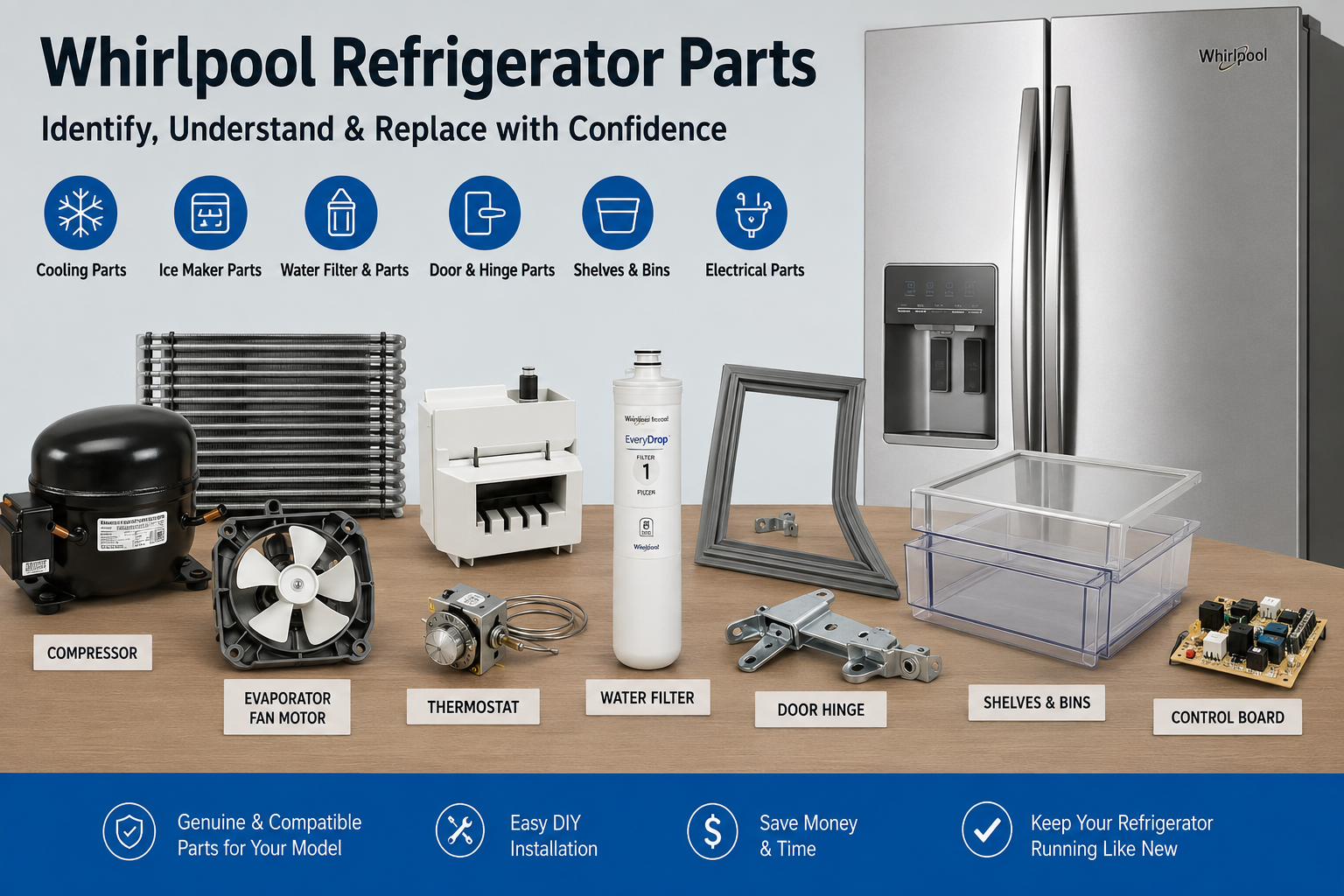
When your refrigerator stops cooling, the ice maker quits working, or a door shelf suddenly cracks, knowing which Whirlpool refrigerator parts you need can save time and money. But refrigerators contain many components, and a part that looks right may not actually fit your specific model.
The safest approach is to identify the problem, locate your refrigerator’s complete model number, and verify the replacement part before ordering. From evaporator fan motors and thermostats to door gaskets, water filters, shelves, and ice maker assemblies, each component has a specific job.
This guide explains the most common Whirlpool refrigerator parts, what they do, which symptoms may indicate a problem, and how to choose the right replacement.
What Are Whirlpool Refrigerator Parts?
Whirlpool refrigerators contain mechanical, electrical, cooling, water, and interior components that work together to preserve food and maintain consistent temperatures.
Some parts are replaced because they wear out, while others may need replacement after accidental damage. Common examples include:
- Compressor and condenser components
- Evaporator fan motors
- Thermostats and thermistors
- Ice maker assemblies
- Water inlet valves
- Water filters
- Door gaskets and hinges
- Shelves, bins, and drawers
- Control boards
- Defrost components
- Interior lights and switches
The correct replacement depends on the refrigerator’s exact model and, in many cases, the original manufacturer’s part number.
Main Whirlpool Refrigerator Parts Explained
Compressor
The compressor is a critical part of the refrigeration system. It circulates refrigerant and helps the refrigerator remove heat from the interior.
A compressor problem can result in poor cooling, unusual noises, or a refrigerator that runs without reaching the desired temperature. Because compressor and sealed-system repairs require specialized tools and knowledge, they are generally not suitable for inexperienced DIY repairs.
Condenser Coils
Condenser coils release heat removed from inside the refrigerator. When coils become dirty or airflow around them is restricted, the appliance may have to work harder to maintain its temperature.
Regular cleaning around accessible condenser areas can help support efficient operation. Always follow the maintenance instructions for your specific model.
Evaporator Coil
The evaporator coil is where refrigerant absorbs heat from the refrigerator’s interior. Problems with airflow, defrosting, or the refrigeration system can cause excessive frost or poor cooling around the evaporator.
If the coil is heavily covered in ice, simply removing the ice may not solve the underlying problem. A failed defrost component, fan, sensor, or control system could be responsible.
Evaporator Fan Motor
The evaporator fan circulates cold air throughout the refrigerator and freezer compartments.
A failing fan may produce unusual noises or cause a situation where the freezer remains relatively cold while the refrigerator section becomes too warm. Diagnosing the fan before purchasing a replacement is important because blocked airflow and other problems can create similar symptoms.
Thermostat and Thermistor
A thermostat and a thermistor both relate to temperature control, but they are not identical components.
A thermostat controls temperature based on a set operating range, while a thermistor is a temperature-sensitive sensor that provides temperature information to the control system.
If your refrigerator is too warm, too cold, or cycling abnormally, one of these components could be involved. However, other parts can create similar symptoms, so replacement should follow proper diagnosis.
Damper Control
The damper regulates airflow between refrigerator compartments in models that use this system.
A damaged or stuck damper can contribute to uneven temperatures. For example, the freezer may be cold while the fresh-food compartment does not receive enough cold air.
Whirlpool Refrigerator Parts by Category
Organizing replacement components by function makes it easier to identify what you need.
| Part Category | Common Parts | Typical Purpose |
| Cooling | Compressor, evaporator, condenser | Refrigeration and heat removal |
| Airflow | Evaporator fan, condenser fan, damper | Moves or controls air |
| Temperature | Thermostat, thermistor, sensors | Monitors and controls temperature |
| Ice maker | Ice maker assembly, fill tube, motor | Produces and dispenses ice |
| Water system | Filter, inlet valve, tubing | Supplies and filters water |
| Door | Gasket, hinge, handle, bins | Seals and supports the door |
| Interior | Shelves, drawers, supports | Provides food storage |
| Electrical | Control board, switches, wiring | Controls appliance functions |
Whirlpool Refrigerator Ice Maker Parts
A refrigerator that stops producing ice does not necessarily have a failed ice maker.
Possible Whirlpool refrigerator parts involved in an ice-making problem include:
- Ice maker assembly
- Ice maker motor or module
- Ice tray
- Water inlet valve
- Fill tube
- Ice bucket
- Auger
- Ice-level components
- Water filter
Example: Ice Maker Stops Making Ice
Before buying a new ice maker, check whether the refrigerator has an adequate water supply and whether the water filter requires replacement. A restricted water filter or faulty inlet valve can prevent the ice maker from receiving enough water.
If the water supply is normal but the ice maker still does not cycle correctly, the ice maker assembly itself may need further testing or replacement.
Whirlpool Refrigerator Water System Parts
Water-related components are particularly important in refrigerators with filtered water and automatic ice makers.
Common parts include:
Water Filter
The filter removes certain contaminants from the refrigerator’s water supply. Filters are routine replacement items and are generally much easier to replace than mechanical or electrical components.
Water Inlet Valve
The inlet valve controls water entering the appliance. A faulty valve can affect both the ice maker and water dispenser.
Water Tubing
Cracked, disconnected, or damaged tubing can cause leaks or prevent water from reaching the dispenser or ice maker.
Water Filter Housing
The housing holds the filter in place and connects it to the refrigerator’s water system. Damage or an improperly installed filter can cause leakage.
Always verify the correct filter and component for your exact refrigerator model rather than choosing solely based on appearance.
Whirlpool Refrigerator Door Parts
Door components are among the most frequently overlooked refrigerator replacement parts.
They can include:
- Door gasket
- Door hinge
- Door handle
- Door bins
- Door shelves
- Door switch
- Hinge covers
- Closing hardware
How to Tell if a Door Gasket Is Damaged
A worn refrigerator door gasket may show visible cracks, gaps, looseness, or deformation. You may also notice condensation, frost buildup, or the refrigerator running more frequently than usual.
Replacing a damaged gasket can be considerably simpler than repairing the refrigeration system, but correct installation and alignment are important.
Interior Whirlpool Refrigerator Parts
Not every replacement involves a mechanical failure.
Sometimes you simply need a replacement:
- Glass shelf
- Crisper drawer
- Pantry drawer
- Drawer cover
- Shelf support
- Door bin
- Interior light
- Air filter
- Storage bracket
These components can often be replaced without specialized tools. Nevertheless, verify the model compatibility before ordering because shelf dimensions and mounting systems vary between refrigerator designs.
Electrical and Control Parts
Modern refrigerators rely on electronic components to monitor temperatures and control functions.
Common electrical Whirlpool refrigerator parts include:
- Main control boards
- Display or user-interface boards
- Thermistors
- Door switches
- Start devices
- Capacitors
- Wiring harnesses
- LED light modules
A control board should not automatically be blamed whenever an electronic function stops working. A failed sensor, switch, wiring connection, or another component can produce similar symptoms.
Replacing an expensive control board without proper diagnosis can turn a minor repair into an unnecessary expense.
Which Whirlpool Refrigerator Part Might Be Causing the Problem?
Symptoms can provide useful clues, but they do not always identify one specific failed part.
| Refrigerator Problem | Possible Parts | What to Check First |
| Refrigerator not cooling | Compressor, fan, thermostat, control board | Temperature settings and airflow |
| Freezer cold but fridge warm | Evaporator fan, damper, airflow system | Air vents |
| Ice maker not working | Ice maker, filter, inlet valve | Water supply |
| Water dispenser not working | Filter, valve, tubing, switch | Filter and water supply |
| Water leaking | Drain, tubing, valve | Where the water originates |
| Heavy frost buildup | Defrost heater, sensor, control | Location of frost |
| Unusual noise | Fan, compressor, ice maker | Source of the sound |
| Door will not seal | Gasket, hinge, alignment | Door and gasket condition |
This type of symptom-based diagnosis is a useful starting point, but it should not be treated as a definitive diagnosis.
How to Find the Correct Whirlpool Refrigerator Parts
The most important step before ordering a replacement is finding the refrigerator’s complete model number.
Find the Model Number
Depending on the model, the identification label may be located inside the refrigerator compartment, around the door frame, or in another manufacturer-designated location.
Do not confuse the model number with the serial number. Both may appear on the same label, but they serve different purposes.
Use the Complete Model Number
A partial model number may return multiple variations of an appliance. Entering the complete model information helps narrow the search to compatible components.
Match the Part Number
Once you have identified the suspected component, compare the replacement’s manufacturer part number with the part specified for your refrigerator.
Before purchasing, verify:
- Complete refrigerator model number
- Replacement part number
- Component type
- Connector configuration
- Dimensions where applicable
- Left/right orientation for doors or handles
- Compatibility with your refrigerator configuration
Never choose a replacement simply because it looks similar to the original.
OEM vs. Aftermarket Whirlpool Refrigerator Parts
You may encounter both OEM and aftermarket replacement components.
| Option | Advantages | Potential Concern |
| OEM Whirlpool part | Designed for the specified appliance | May cost more |
| Aftermarket compatible | Can offer lower-cost alternatives | Quality and compatibility vary |
| Universal part | May fit multiple appliances | Requires careful compatibility checks |
| Used part | May be less expensive | Previous wear can be uncertain |
OEM means the component is produced for the manufacturer’s appliance specifications. Aftermarket parts can be perfectly suitable in some situations, but compatibility and quality should be carefully evaluated.
For important components, particularly electronic or refrigeration-system parts, choosing a reputable source and verifying compatibility is more important than simply choosing the lowest price.
Which Whirlpool Refrigerator Parts Can You Replace Yourself?
Some replacement jobs are relatively straightforward, while others require technical knowledge.
| Part | DIY Difficulty | General Guidance |
| Water filter | Easy | Routine replacement |
| Shelf or bin | Easy | Usually simple |
| Door gasket | Easy–Moderate | Alignment matters |
| Ice maker assembly | Moderate | Model-specific |
| Fan motor | Moderate | Requires access and diagnosis |
| Thermostat or sensor | Moderate | Electrical knowledge may help |
| Control board | Advanced | Diagnose before replacing |
| Compressor | Professional | Specialized refrigeration work |
Always disconnect power before servicing electrical components when the manufacturer’s instructions require it.
Refrigerant and sealed-system work should be handled by appropriately qualified professionals. Attempting complex repairs without the correct equipment can create safety risks and potentially damage the appliance.
Common Mistakes When Buying Whirlpool Refrigerator Parts
Buying by appearance
Two components can look nearly identical but have different specifications or connectors.
Using an incomplete model number
A partial model number can lead to the wrong replacement.
Replacing a part without diagnosing the problem
A refrigerator that is not cooling may have several possible causes. Replacing the first component that seems suspicious can waste money.
Ignoring installation details
Door gaskets, fans, electrical components, and water-system parts must be installed correctly to function properly.
Choosing the cheapest part automatically
Price should be considered alongside compatibility, quality, warranty, and the importance of the component.
How to Maintain Whirlpool Refrigerator Parts
Good maintenance can reduce unnecessary wear on refrigerator components.
- Keep accessible condenser areas clean according to manufacturer guidance.
- Replace water filters according to the instructions for your model.
- Keep refrigerator vents clear.
- Avoid blocking airflow with tightly packed food.
- Inspect door gaskets for cracks or gaps.
- Clean spills promptly.
- Pay attention to new or unusual noises.
- Address temperature changes before they become major problems.
Small warning signs can sometimes help you catch a developing issue before a more expensive component is affected.
When Should You Repair or Replace the Refrigerator?
Replacing one damaged shelf or water filter usually makes sense. More extensive repairs require a broader evaluation.
Consider the refrigerator’s:
- Age
- Overall condition
- Repair history
- Cost of replacement parts
- Labor cost
- Energy efficiency
- Availability of compatible parts
- Expected remaining service life
For example, replacing a damaged door bin on an otherwise reliable refrigerator is generally a straightforward decision. On the other hand, an older appliance requiring several expensive major components may deserve a repair-versus-replacement comparison.
Conclusion
Finding the right Whirlpool refrigerator parts is easier when you approach the repair systematically. Identify the refrigerator model, understand the component involved, diagnose the likely cause, and verify the replacement part before ordering.
Simple components such as filters, shelves, bins, and some gaskets may be suitable for DIY replacement. More complicated components—including compressors, sealed-system parts, and certain electrical controls—can require professional diagnosis and repair.
Most importantly, don’t choose a replacement based only on appearance. The complete model number and correct part number are your best tools for finding a compatible replacement and avoiding an unnecessary purchase.
Frequently Asked Questions
How do I find the right Whirlpool refrigerator parts?
Start with the refrigerator’s complete model number. Then identify the failed or damaged component and verify its manufacturer part number and compatibility before ordering.
Where can I find my Whirlpool refrigerator model number?
The model number is commonly found on a product identification label inside the refrigerator compartment or around the door area. The exact location varies by model.
Are Whirlpool refrigerator parts interchangeable?
Not necessarily. Parts can differ between models, configurations, production revisions, and refrigerator designs. Always verify compatibility using the complete model number and applicable part number.
What Whirlpool refrigerator parts commonly need replacement?
Common replacement components include water filters, door gaskets, shelves, drawers, ice maker assemblies, fan motors, water inlet valves, thermostats, and various electrical components.
Can I replace Whirlpool refrigerator parts myself?
Some parts, such as filters, shelves, bins, and certain gaskets, are generally accessible to homeowners. More complicated electrical, refrigeration, and sealed-system repairs may require qualified professional service.
Should I buy OEM Whirlpool refrigerator parts?
OEM parts can be a good choice when exact compatibility and manufacturer specifications are important. Quality aftermarket parts may also be suitable, but compatibility should always be verified before purchase.
How do I know which refrigerator part is causing the problem?
Start with the symptom and inspect the simplest potential causes first. Because multiple components can produce similar symptoms, avoid replacing expensive parts without appropriate diagnosis.