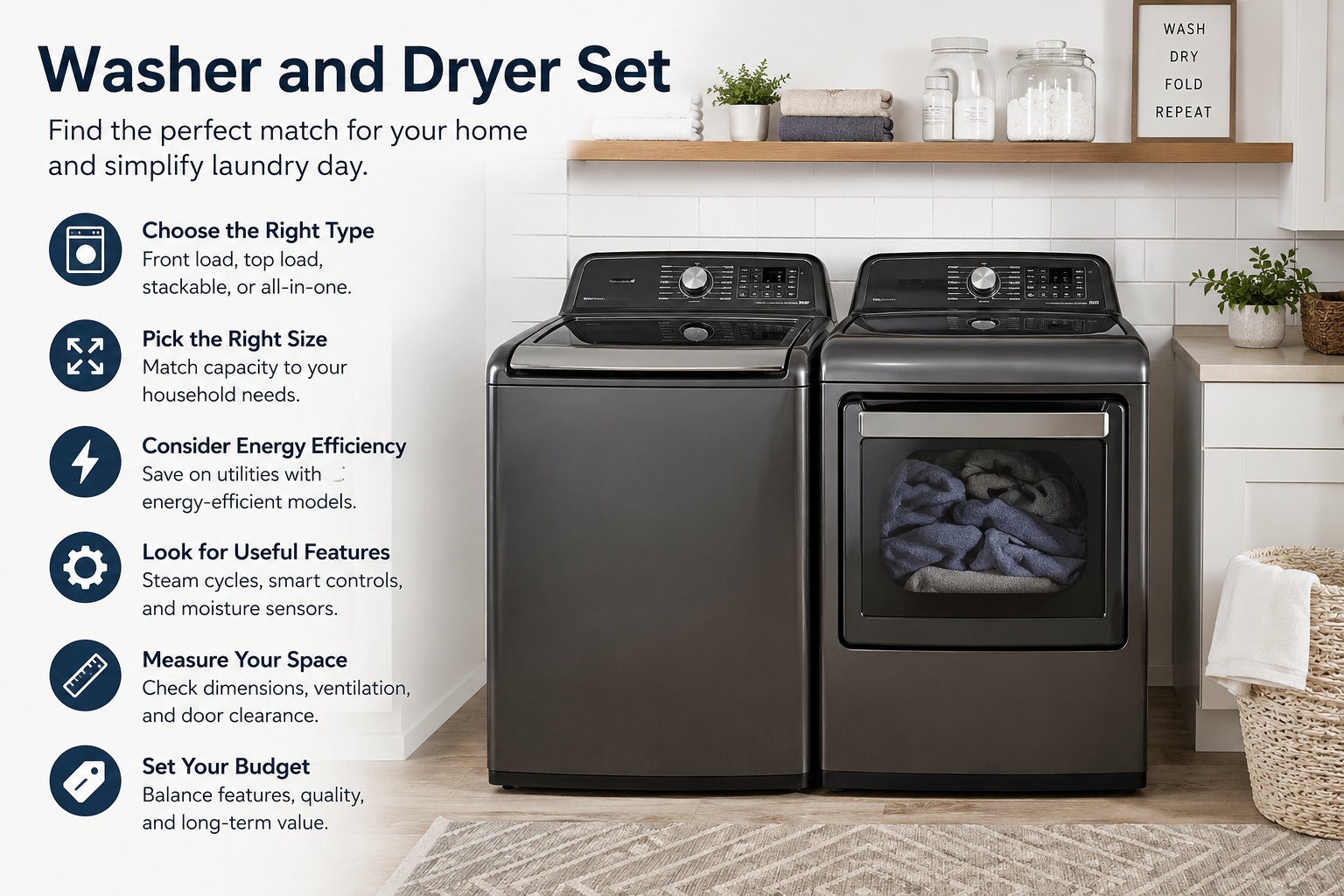
Choosing a washer and dryer set is about more than finding two appliances that look good together. The right pair should fit your laundry space, handle your typical load sizes, match your available hookups, and provide the features you will actually use.
A good washer and dryer set can make laundry faster and more convenient while helping control water and energy use. But with front-load, top-load, stackable, gas, electric, vented, ventless, and smart models available, the buying process can quickly become confusing.
The best approach is to start with your household and installation needs rather than a specific brand or feature. This guide explains the key differences, capacity considerations, installation requirements, useful features, and common mistakes to help you choose confidently.
What Is a Washer and Dryer Set?
A washer and dryer set is a coordinated washing machine and clothes dryer designed to work well together. Matching sets often share a similar appearance, capacity range, controls, and laundry technology.
Buying a pair can simplify shopping because you do not have to compare two completely unrelated appliances. It may also provide a consistent look and compatible features.
However, you do not always have to buy both appliances together. If your existing dryer is relatively new, for example, replacing only an old washer may make more financial sense.
Why Buy a Matching Washer and Dryer?
A matching set can offer several advantages:
- Coordinated design
- Compatible capacities
- Similar control systems
- Easier shopping
- Potential bundle promotions
- Consistent laundry cycles
- Simplified service and support
The biggest benefit is convenience. Instead of trying to determine whether two unrelated models will work well together, you can select a manufacturer-designed pair.
Can You Mix and Match Brands?
Yes, in many cases you can use a washer and dryer from different brands. They do not need to communicate with each other for basic washing and drying functions.
However, stacking is different. If you plan to stack appliances, the manufacturer must specifically approve the models for that configuration, and you may need a compatible stacking kit.
Types of Washer and Dryer Sets
Understanding the available configurations is the first major buying decision.
Front-Load Washer and Dryer Sets
Front-load washers open from the front and are often paired with matching dryers placed side by side. Many compatible front-load pairs can also be stacked.
They can be a strong choice for households that prioritize efficient operation, larger loads, or flexible installation.
The main consideration is accessibility. Because the door is low to the ground, loading and unloading may require more bending.
Top-Load Washer and Dryer Sets
Top-load washers open from above, making it easier for many people to load clothing without bending as far.
They are available with agitators or impellers. Agitator models use a central mechanism to move clothing through the wash, while impeller models use a low-profile plate or similar mechanism.
Top-load models can be particularly appealing to shoppers who prefer traditional loading or easier access.
Stackable Washer and Dryer Sets
Stackable sets are designed to save floor space by placing the dryer above the washer.
They are especially useful in apartments, closets, and compact laundry rooms. However, not every washer and dryer can be stacked. Always check manufacturer compatibility and installation requirements before purchasing.
Laundry Centers
A laundry center combines the washer and dryer into one vertically arranged appliance configuration. It can provide a compact footprint where side-by-side machines would take up too much room.
The trade-off is that you generally have fewer configuration options than with separate appliances.
All-in-One Washer-Dryer Combos
An all-in-one machine washes and dries clothes in the same appliance.
This configuration can be attractive when space is extremely limited or when transferring wet clothing between machines is inconvenient. However, cycle times and drying capacity can differ significantly from conventional separate appliances.
Front-Load vs. Top-Load: Which Is Better?
There is no universal winner. The better option depends on your space, accessibility preferences, laundry habits, and desired features.
| Feature | Front-Load | Top-Load |
| Loading | Front opening | Top opening |
| Stacking | Often possible with compatible models | Generally not stackable |
| Accessibility | Requires more bending | Easier top access |
| Space flexibility | Excellent when stacked | Usually side-by-side |
| Agitator | No | Available on some models |
| Impeller | No | Available on some models |
| Best for | Efficiency and flexible installation | Easy loading and traditional use |
For example, someone living in a small apartment may benefit from a stackable front-load washer and dryer set. A homeowner with plenty of floor space who prefers standing access may prefer a top-load washer.
How to Choose the Right Capacity
Capacity is one of the most important specifications to consider, but household size should not be your only deciding factor.
Think about how often you do laundry and what you wash.
A couple who washes small loads several times a week may not need the same capacity as a family of five that washes towels, bedding, and clothing in large batches.
Consider Your Laundry Habits
Ask yourself:
- How many loads do you wash each week?
- Do you frequently wash towels?
- Do you wash comforters or large blankets?
- Do you have children with frequent laundry needs?
- Do you wash pet bedding?
- Do you prefer fewer, larger loads?
A larger drum can be useful for bulky items, but buying the biggest appliance available is not automatically better. Larger machines can require more space and may cost more.
Why Dryer Capacity Is Often Larger
Dryers generally need enough open space around clothing for effective tumbling and airflow. As a result, it is common for a matching dryer to have a larger listed capacity than its paired washer.
Rather than trying to make the numbers identical, choose a coordinated set according to the manufacturer’s specifications.
Measure Your Laundry Space Before Buying
One of the easiest mistakes to avoid is purchasing a washer and dryer set before measuring the installation area.
Measure:
- Available width
- Available height
- Available depth
- Door and lid clearance
- Space behind the appliances
- Space between machines
- Hallways and doorways
- Stairways and tight corners
- Water connections
- Drain location
- Electrical outlet
- Gas connection, if applicable
- Dryer vent location
Delivery access matters just as much as the final installation space. A machine can fit perfectly in your laundry room and still fail to pass through a narrow doorway.
Don’t Forget Stacking Height
If you are considering a stackable washer and dryer set, measure the total height of the stacked appliances and make sure you can comfortably reach the controls.
Always use an approved stacking kit when the manufacturer requires one.
Gas vs. Electric Dryers
Your home’s existing infrastructure can heavily influence which dryer makes sense.
Electric Dryers
Electric dryers are widely available and do not require a household gas connection.
They can be a practical choice for homes where electrical service is already configured for the appliance and installing a gas line would be unnecessary or expensive.
Gas Dryers
Gas dryers require an appropriate gas connection as well as electrical power for their controls and other components.
They can make sense when a suitable gas hookup already exists, but installation should be handled according to local requirements and manufacturer instructions.
Rather than assuming one fuel type is always cheaper or better, compare the appliance requirements, utility costs, installation expenses, and your home’s existing setup.
Vented vs. Ventless Dryers
Traditional dryers typically exhaust warm, moist air through an exterior vent. This requires an appropriate vent route and regular lint maintenance.
Ventless dryers do not require the same type of exterior exhaust connection and can offer greater flexibility in some installations.
Heat-pump dryers are one type of ventless technology and can be attractive to shoppers who prioritize energy efficiency.
For apartments, condos, or unusual laundry-room layouts, checking vent requirements before buying can prevent expensive installation problems.
Which Washer and Dryer Features Are Worth Paying For?
Modern appliances can include dozens of cycles and smart features. The trick is separating useful technology from features you may rarely use.
Features Worth Considering
Moisture sensors: These can help a dryer determine when clothes are sufficiently dry rather than relying only on a fixed timer.
High spin speeds: A washer that removes more moisture during the spin cycle can potentially reduce the amount of work required from the dryer.
Steam cycles: Steam can be useful for certain clothing-care and wrinkle-reduction applications.
Sanitize cycles: These may be useful for specific laundry needs, but they should not be treated as necessary for every household.
Automatic detergent dispensing: Convenient for households that prefer automated dosing.
Smart controls: Wi-Fi connectivity can provide remote notifications, cycle monitoring, diagnostics, and other conveniences.
Features You May Not Need
A premium washer and dryer set is not automatically a better washer and dryer set.
If you rarely use specialty cycles, do not care about smartphone controls, or prefer simple physical controls, spending more for advanced technology may provide little practical benefit.
Prioritize features that solve a problem you actually have.
How Energy Efficiency Affects Long-Term Cost
The purchase price is only part of the cost of owning a washer and dryer.
Your long-term expenses can include:
Purchase price + installation + electricity/gas + water + detergent + maintenance + repairs
High-efficiency washers may reduce water consumption, while efficient dryers and moisture-sensing technology can help manage energy use.
When comparing models, look beyond marketing language and review the manufacturer’s specifications and applicable energy information.
A slightly more expensive appliance can sometimes make sense if it better matches your usage and operating needs.
Choosing a Washer and Dryer Set for Different Households
For Small Apartments
Look for:
- Stackable designs
- Compact dimensions
- Ventless drying options where appropriate
- Easy delivery access
For Large Families
Prioritize:
- Larger capacity
- Strong everyday cycles
- Bedding and bulky-item capability
- Efficient operation for frequent loads
For Couples or Small Households
A moderate-capacity washer and dryer set may provide a better balance between purchase price, space, and actual laundry volume.
For Bulky Laundry
If you frequently wash comforters, towels, blankets, or other large items, prioritize usable drum space and manufacturer-approved bulky-load capability.
For Smart Homes
Wi-Fi controls, mobile notifications, remote diagnostics, and smart-home compatibility can be valuable if you genuinely use connected appliances.
Common Washer and Dryer Buying Mistakes
Buying Before Measuring
Never rely on estimated dimensions. Measure the laundry room and delivery path first.
Choosing Capacity Only by Household Size
Two four-person households can have completely different laundry habits. Consider actual load frequency and the types of items you wash.
Forgetting Installation Requirements
Check electrical, gas, water, drainage, and vent requirements before purchasing.
Assuming Every Washer Can Be Stacked
Stacking requires compatible appliances and, where specified, the correct stacking hardware.
Paying for Features You Won’t Use
A long feature list does not automatically equal better value.
Ignoring Warranty and Service
Before purchasing, understand the warranty terms and consider whether authorized service is readily available in your area.
Washer and Dryer Set Buying Checklist
Before placing an order, confirm:
- Your available space
- Delivery-path measurements
- Washer capacity
- Dryer capacity
- Front-load or top-load configuration
- Side-by-side or stacked installation
- Electrical requirements
- Gas requirements
- Dryer ventilation
- Water and drainage connections
- Important wash and dry cycles
- Energy-efficiency information
- Warranty coverage
- Installation costs
- Long-term operating costs
Conclusion
The right washer and dryer set should fit your home and your laundry habits—not simply have the longest list of features. Start by measuring your space, checking your hookups, estimating your typical laundry volume, and deciding whether front-load, top-load, stacked, or another configuration suits your lifestyle.
Then compare capacity, drying technology, efficiency, useful features, installation requirements, warranty coverage, and long-term ownership costs. Taking those steps before shopping can help you avoid compatibility problems and choose a set that delivers practical value for years to come.
Frequently Asked Questions
Is it better to buy a washer and dryer as a set?
A matching set can simplify compatibility, appearance, and shopping. However, buying separately can make sense when one existing appliance is still in good condition or when a different model better fits your needs.
What size washer and dryer do I need?
The right capacity depends on household size, laundry frequency, and the types of items you wash. Families that regularly wash bedding and bulky loads generally benefit from more capacity than households doing smaller loads.
Are front-load or top-load washer and dryer sets better?
Neither is universally better. Front-load sets offer flexible stacking options and can be attractive for efficiency-focused households, while top-load washers provide convenient top access.
Can any washer and dryer be stacked?
No. Only compatible appliances designed for stacking should be stacked. Check the manufacturer’s specifications and use the required stacking hardware.
Is a gas or electric dryer better?
The best choice depends largely on your existing hookups, installation requirements, utility costs, and preferences. A suitable existing connection can make one option much more practical than the other.
How much space does a washer and dryer set need?
Space requirements vary by model. Measure width, height, depth, door clearance, rear connections, and delivery access before buying. Stacked configurations also require sufficient vertical clearance.
Should my washer and dryer have the same capacity?
They do not necessarily need identical capacities. Dryers are often designed with more drum space to allow clothes to tumble freely. Follow the manufacturer’s recommended pairing for the specific models.