
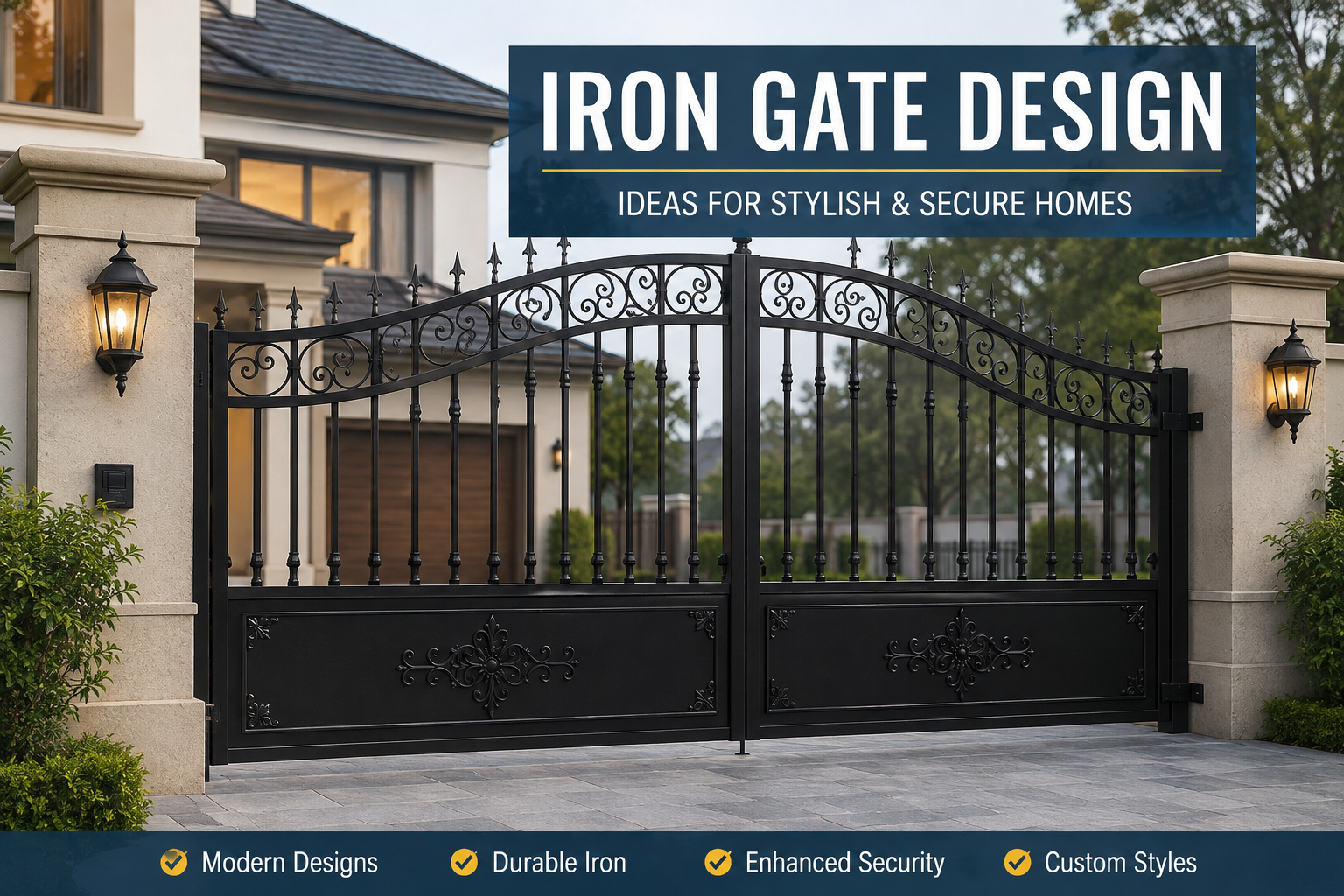
An iron gate is more than an entrance barrier. It can shape the first impression of a property, improve security, define privacy, and complement the architecture of a home. The right iron gate design should therefore balance appearance with practical needs such as available space, durability, maintenance, and ease of access.
From sleek modern gates and simple geometric patterns to classic wrought iron and elaborate ornamental styles, there are options for almost every type of property. The best choice depends on your home’s architectural style, driveway layout, security requirements, and personal preferences.
This guide explores popular iron gate designs, compares common gate types, and explains how to choose a style that works for your property.
Popular Iron Gate Design Ideas
1. Modern Minimalist Iron Gate
Modern homes often look best with clean lines and restrained decoration. A minimalist iron gate may use vertical or horizontal bars, geometric panels, or simple rectangular patterns.
Matte black, charcoal, and other understated finishes can complement contemporary walls and exterior colors.
Best for: Modern houses, townhomes, and contemporary villas.
2. Classic Wrought Iron Gate
A traditional wrought iron gate can feature curved lines, scrollwork, decorative finials, and symmetrical patterns. This style creates an elegant appearance and works particularly well with classic architecture.
Because decorative details can be customized, homeowners can create anything from a relatively simple traditional gate to a highly ornate entrance.
Best for: Traditional homes, villas, historic-style properties, and formal entrances.
3. Simple Iron Gate Design
Not every property needs elaborate metalwork. A simple iron gate can use straight vertical bars with a sturdy frame and minimal decoration.
This approach is practical when you want durability and security without making the entrance visually overwhelming.
Best for: Budget-conscious projects, minimalist homes, and smaller entrances.
4. Geometric Iron Gate
Geometric designs use squares, rectangles, lines, and symmetrical patterns to create a contemporary appearance.
These designs can be particularly effective when the gate needs to match modern architectural features such as large windows, straight rooflines, or minimalist boundary walls.
5. Ornamental Iron Gate
Ornamental gates emphasize craftsmanship. Scrolls, curves, floral-inspired details, decorative points, and custom patterns can give the entrance a distinctive appearance.
However, more decoration generally means more fabrication detail, so design complexity should be considered when planning the budget.
6. Iron and Wood Gate
Combining iron with wood can create a balance between strength and warmth. The iron frame provides a strong visual structure while wood panels can increase privacy.
This combination works especially well with contemporary, rustic, and transitional architecture.
7. Sliding Iron Gate
A sliding gate moves horizontally rather than swinging into the driveway. It can be useful when there is limited clearance in front of the entrance.
A sliding system does, however, require adequate space alongside the boundary for the gate to move and appropriate hardware or a track system.
8. Double Iron Gate
Double gates have two opening sections and are commonly used for wider driveways. They can create a balanced, symmetrical entrance and make vehicle access convenient.
The correct configuration depends on the available opening, driveway layout, vehicle requirements, and hardware.
Modern vs. Traditional Iron Gate Designs
Choosing between modern and traditional styling often comes down to the architecture of the property.
| Feature | Modern Iron Gate | Traditional Iron Gate |
| Design | Clean and geometric | Curved and ornamental |
| Decoration | Minimal | More detailed |
| Appearance | Sleek and contemporary | Classic and elegant |
| Best for | Modern architecture | Traditional architecture |
| Common patterns | Lines, grids, panels | Scrolls, arches, finials |
| Privacy options | Often easy to incorporate | Usually more open |
| Customization | High | High |
A modern home with strong geometric features may look more cohesive with a simple contemporary gate. A traditional property may benefit from decorative ironwork that reflects its architectural character.
Iron Gate Designs for Different Home Styles
Modern Homes
Choose straight lines, geometric patterns, minimalist frames, and understated finishes. Avoid excessive decorative elements if the rest of the property has a clean architectural style.
Traditional Homes
Classic scrollwork, arches, decorative finials, and symmetrical designs can complement traditional facades.
Luxury Villas
Large double gates with custom ornamental details can create a formal entrance. A personalized design may incorporate architectural motifs or other decorative elements.
Farmhouse or Rustic Homes
Simple ironwork combined with wood or understated decorative elements can provide a less formal appearance.
Mediterranean-Style Properties
Arched shapes, decorative curves, and elaborate metalwork can work particularly well with Mediterranean-inspired architecture.
Sliding vs. Swing Iron Gates
The gate’s opening mechanism is just as important as its appearance.
| Consideration | Sliding Gate | Swing Gate |
| Front clearance | Requires less opening space | Requires swing clearance |
| Side clearance | Requires space along boundary | Usually less side space |
| Appearance | Contemporary to traditional | Very versatile |
| Automation | Possible | Possible |
| Best suited to | Restricted front space | Properties with adequate clearance |
| Main consideration | Track/rolling mechanism | Hinges and opening arc |
A homeowner with a short driveway may prefer a sliding configuration because a swing gate could interfere with parked vehicles. Conversely, a spacious entrance may make a double swing gate an attractive option.
There is no universally better option. The property layout should determine the mechanism.
Choosing an Iron Gate for Security
An attractive gate does not automatically provide strong security. Security depends on the complete system, including the gate’s construction, frame, hinges, locks, access controls, surrounding walls, and installation.
When security is a priority, consider:
- Strong structural framing
- Appropriate gate height
- Suitable bar or panel spacing
- Quality hinges and locks
- Reliable access-control hardware
- Proper installation
- Adequate lighting around the entrance
- Automation where appropriate
Visibility is another consideration. Open-bar designs allow homeowners to see through the entrance, while solid or semi-solid designs can provide greater privacy.
The right solution depends on the property’s location and specific security requirements.
Iron Gate Designs for Privacy
Privacy and visibility often involve a trade-off.
Traditional open-bar gates can provide an attractive entrance while allowing visibility into and out of the property. If privacy is more important, consider:
- Solid metal panels
- Closely spaced vertical elements
- Perforated metal panels
- Iron and wood combinations
- Decorative upper sections with more enclosed lower sections
For example, a home directly facing a busy street may benefit from a semi-private gate rather than a completely open decorative design.
Wrought Iron vs. Steel Gates
The terms “iron gate” and “wrought iron gate” are sometimes used broadly, but the material and fabrication method matter.
Wrought iron is traditionally associated with decorative and handcrafted metalwork, while steel is widely used for both structural and contemporary gate applications.
The best choice depends on the desired design, construction method, finish, environmental conditions, and budget. Rather than assuming one material is always superior, ask the fabricator about the specific material grade, construction, protective coating, and expected maintenance.
Choosing the Right Iron Gate Design
Before selecting a design, consider these factors.
1. Match the Architecture
The gate should look like part of the property rather than an unrelated addition.
2. Measure the Opening
The available width and surrounding space influence whether a single, double, sliding, or swing configuration makes sense.
3. Consider Privacy
Decide whether you want an open view, partial privacy, or a more enclosed entrance.
4. Define Security Needs
Think about locks, access control, height, construction, and surrounding property security.
5. Choose the Finish
The finish should complement exterior walls, doors, windows, and other architectural details.
6. Think About Maintenance
Ask how the metal should be cleaned, protected, inspected, and repaired.
7. Consider Automation
If you want an automated gate, confirm that the chosen design and hardware can accommodate the appropriate automation system.
What Affects Iron Gate Cost?
There is no single price that applies to every iron gate. The final cost can vary considerably depending on the project.
Important factors include:
- Gate dimensions
- Material
- Metal thickness and construction
- Design complexity
- Decorative detailing
- Sliding or swing mechanism
- Automation
- Surface preparation
- Protective finish
- Installation
- Site conditions
- Custom fabrication
A simple gate with clean lines may require less fabrication than an elaborate handcrafted design. Ask for a detailed quotation that separates fabrication, hardware, finishing, automation, and installation where possible.
Iron Gate Maintenance Tips
Even a well-built gate benefits from routine care.
Inspect the surface periodically for rust, damaged coating, loose hardware, or signs of corrosion. Clean accumulated dirt and debris, particularly around hinges and moving parts.
Sliding gates should have their tracks and rollers checked regularly. Swing gates should have their hinges inspected and lubricated according to the manufacturer’s or installer’s recommendations.
If corrosion has progressed beneath the coating or structural damage is visible, professional repair may be more appropriate than simply applying another layer of paint.
Common Iron Gate Design Mistakes
One common mistake is choosing a design before considering the property’s dimensions. A beautiful gate may not function properly if there is insufficient swing clearance or room for a sliding mechanism.
Another mistake is prioritizing decoration over functionality. The gate should accommodate vehicles, pedestrians, security hardware, and automation where required.
Homeowners should also avoid selecting a finish without considering the property’s environment and maintenance requirements.
Finally, don’t overlook hardware. Hinges, locks, rollers, tracks, and automation components are essential parts of the finished gate.
Real-World Design Examples
Small urban entrance: A simple sliding iron gate can provide security without requiring a large swing area.
Modern villa: A geometric iron frame with wood or metal infill can provide contemporary style and increased privacy.
Traditional home: An ornamental wrought iron gate with curved details can complement classic architecture.
Large driveway: A double swing or sliding gate can make vehicle access more practical, depending on the property’s layout.
Road-facing property: A semi-solid design can reduce visibility while retaining decorative elements.
Questions to Ask an Iron Gate Fabricator
Before ordering a custom gate, ask:
- What material is being used?
- What type of protective finish is recommended?
- Is the gate suitable for automation?
- What hardware is included?
- How will the gate be supported?
- What maintenance will it require?
- Does installation include all necessary preparation?
- What workmanship or product warranty is provided?
- How will corrosion be addressed?
- Can you show examples of similar completed projects?
These questions can help you compare quotations based on quality rather than price alone.
Conclusion
The best iron gate design is not necessarily the most elaborate or expensive option. It is the one that fits the architecture of your home while providing the right combination of security, privacy, accessibility, durability, and visual appeal.
Whether you prefer a minimalist modern gate, classic wrought iron, a sliding driveway gate, or a custom ornamental entrance, consider how the design will function every day—not just how it looks in a photograph. Taking time to evaluate the material, opening mechanism, finish, hardware, and installation can help you choose a gate that remains attractive and practical for years.
Frequently Asked Questions
What is the best iron gate design for a modern home?
Minimalist and geometric designs are usually a natural fit for modern architecture. Straight lines, simple patterns, and restrained finishes can complement contemporary facades.
Is a sliding or swing iron gate better?
Neither is universally better. Sliding gates can work well where front clearance is limited, while swing gates can be suitable when there is sufficient space for the opening arc.
Are iron gates good for security?
They can provide an important layer of property security when properly designed, constructed, installed, and combined with suitable locks and access-control systems.
Which iron gate design provides the most privacy?
Solid or semi-solid designs generally provide more privacy than traditional open-bar gates. Iron and wood combinations can also provide a balance between privacy and decorative appeal.
Can an iron gate be automated?
Yes, many iron gates can be fitted with automation systems. The gate’s weight, dimensions, opening mechanism, hardware, and installation conditions should be assessed before selecting an operator.
How do I prevent an iron gate from rusting?
Use an appropriate protective finish, keep the surface clean, inspect it regularly, and repair damaged coating or corrosion promptly. The appropriate protection depends on the material and environment.
How do I choose the right iron gate design?
Start with your home’s architecture, entrance dimensions, security needs, privacy requirements, available space, maintenance expectations, and budget. Then choose a design that balances appearance and function.