
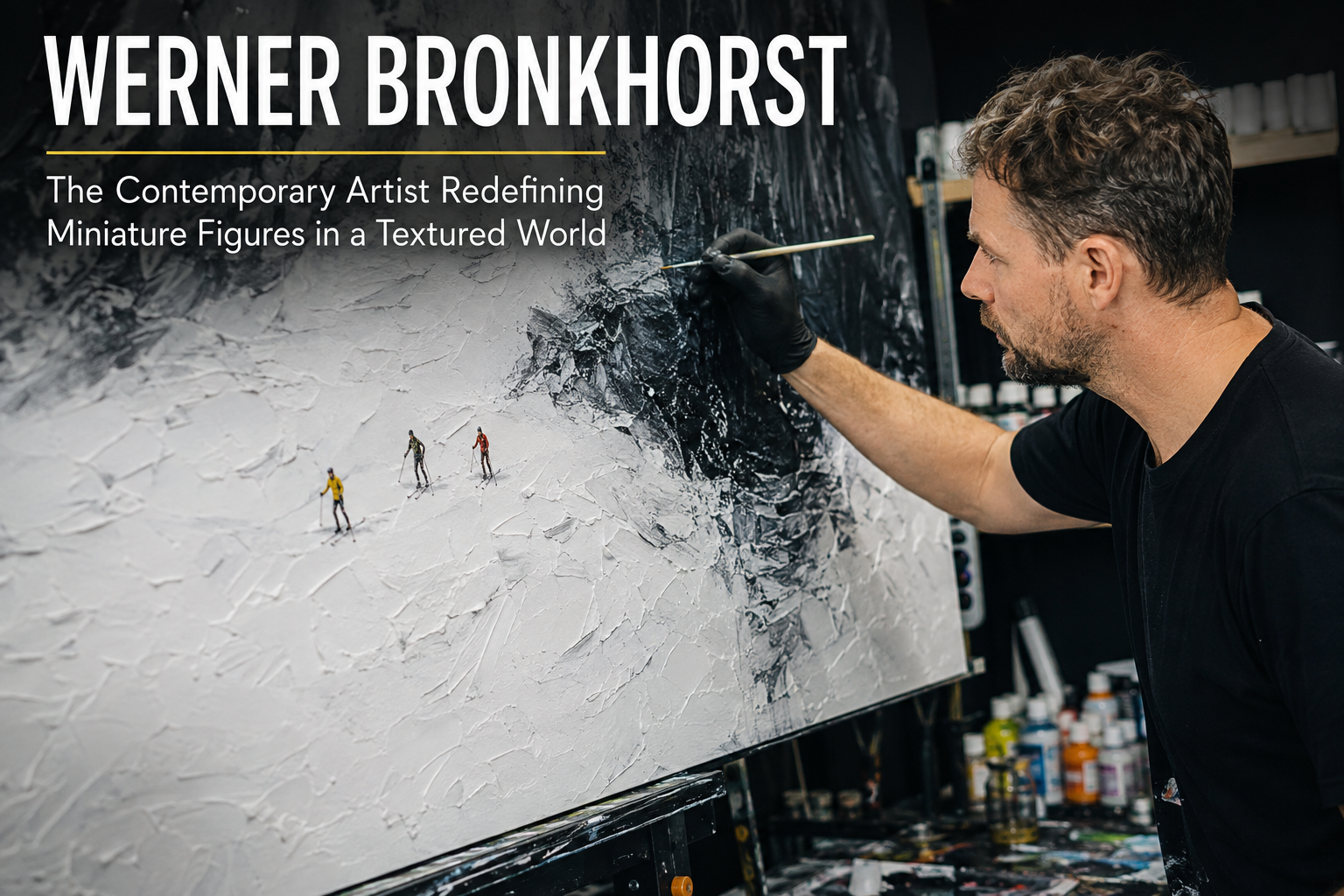
Werner Bronkhorst has become one of the most recognizable contemporary artists of his generation, thanks to an artistic style that makes viewers stop scrolling and look twice. His paintings often place tiny, highly detailed human figures inside vast, heavily textured environments, creating an unusual contrast between realism and abstraction.
A skier may move across a textured white landscape. A swimmer may appear almost lost in a blue surface. A small figure can suddenly transform an abstract canvas into a scene filled with movement, emotion, and narrative.
Born in South Africa and based in Australia, Werner Bronkhorst developed his artistic identity through experimentation, craftsmanship, texture, and an understanding of how visual storytelling works in the digital age. His work spans miniature figures, sporting scenes, textured landscapes, and automotive-inspired charcoal art.
Today, Werner Bronkhorst art reaches an international audience through exhibitions, galleries, collections, and social media. His rise demonstrates how a distinctive artistic voice and a compelling creative process can help an independent artist build global recognition.
Who Is Werner Bronkhorst?
Werner Bronkhorst is a South African-born, Australia-based contemporary artist known for his miniature figures, textured abstract paintings, and detailed automotive artworks. He is especially recognized for placing small, realistic figures inside expansive, heavily textured environments that appear both abstract and three-dimensional.
His art often explores movement, sport, travel, nature, human activity, and the relationship between people and the larger world around them.
What makes Werner Bronkhorst paintings particularly distinctive is the contrast of scale. A tiny figure may occupy only a small portion of the canvas, yet that figure becomes the visual focal point and gives the surrounding landscape a story.
His artistic philosophy is often associated with the idea that the world itself can become a canvas. Instead of limiting creativity to traditional subjects or surfaces, he explores the possibilities within texture, material, movement, and unexpected visual combinations.
Werner Bronkhorst at a Glance
| Detail | Information |
| Name | Werner Bronkhorst |
| Profession | Contemporary visual artist |
| Origin | South Africa |
| Based In | Australia |
| Known For | Miniature figures and textured paintings |
| Other Art Style | Automotive charcoal art with bold text |
| Recurring Themes | Sport, movement, water, landscapes and human activity |
| Artistic Approach | Realistic detail combined with abstraction |
This combination of biography, technique, and visual storytelling helps explain why Werner Bronkhorst artwork appeals to both traditional art audiences and people discovering contemporary art through social media.
Werner Bronkhorst Biography and Early Creative Journey
Growing Up in South Africa
Werner Bronkhorst’s creative identity was shaped by a broad interest in art, movement, materials, and visual expression. His South African background also remained an important part of his personal journey before his later artistic development in Australia.
His work does not follow the traditional path of an artist who simply trained in one discipline and continued with a single technique. Instead, his career has been shaped by experimentation and a willingness to move between creative worlds.
That experimental mindset later became one of the defining characteristics of his art.
Moving to Australia
After moving to Australia, Bronkhorst continued developing his professional and creative direction. The transition eventually helped create the conditions for him to return to art with greater focus.
Australia became an important base for his work, but his art was never limited to one location. The themes found in his paintings are widely recognizable. Sport, travel, movement, water, snow, cars, and everyday human activity can connect with viewers from different countries and backgrounds.
From Craftsmanship to Fine Art
Before becoming widely known as a professional artist, Bronkhorst developed experience in craftsmanship and furniture-related work. This practical relationship with materials helped influence the physical qualities seen in his paintings.
Rather than treating a canvas as a completely flat surface, his work often gives texture a major role.
Layers, gels, and sculptural surfaces can become part of the artwork itself. In many cases, the background is not simply a background. It becomes an environment that helps create the entire story.
How Werner Bronkhorst Developed His Signature Style
Werner Bronkhorst did not become known simply by repeating a conventional painting formula. His style developed through experimentation with materials and processes.
Experimenting With Texture
Texture is central to many Werner Bronkhorst paintings. Thick surfaces can create the appearance of water, roads, snow, sand, landscapes, and abstract spaces.
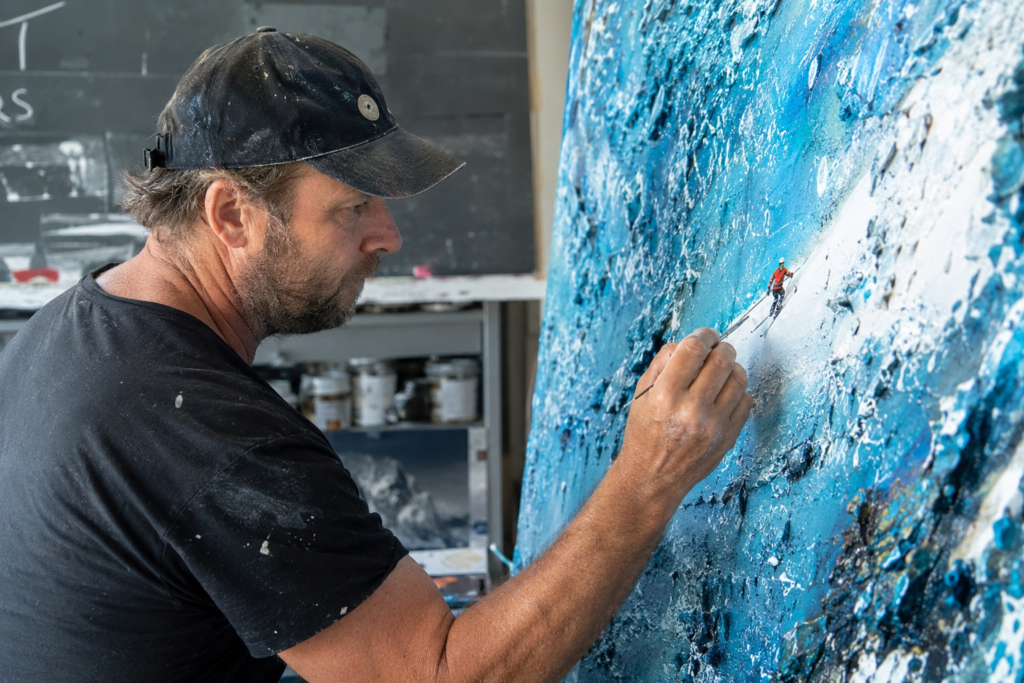
The process is visually powerful because viewers often see something different depending on their perspective. From a distance, the canvas may appear to be an abstract composition. Up close, tiny human figures and detailed elements reveal themselves.
This creates an important visual surprise.
A viewer might first notice a blue textured surface and then discover a tiny swimmer. A white sculptural area might initially look abstract before revealing a skier crossing the scene.
Realism Meets Abstraction
One of the most important elements of Werner Bronkhorst art style is the combination of two very different visual approaches.
The figures can be highly detailed and realistic.
The environments around them can be loose, abstract, and heavily textured.
This contrast creates tension between control and spontaneity. The tiny human figure appears carefully planned, while the larger environment may feel unpredictable.
That combination is one reason his work is easy to recognize.
Why Are the Figures in Werner Bronkhorst’s Paintings So Small?
The miniature figures are among the most recognizable features of his work.
Their small size creates a strong sense of scale. It can make a single person appear vulnerable, adventurous, playful, isolated, or free, depending on the scene.
The technique also encourages the viewer to complete the story.
A tiny person walking through a vast surface raises questions. Where are they going? What is happening around them? Is the environment realistic, imagined, peaceful, or dangerous?
This open-ended quality gives the artwork greater emotional flexibility.
Scale Changes the Meaning of a Scene
Imagine a painting of a surfer surrounded by a huge textured blue surface.
If the surfer were painted at the same scale as the surrounding environment, the work might appear to be a conventional sports scene.
By making the surfer extremely small, the composition changes. The viewer becomes more aware of the relationship between the individual and the wider world.
The same idea can apply to a skier, swimmer, golfer, sailor, or pedestrian.
The figure becomes small, but its story becomes larger.
The Role of Sport and Movement in Werner Bronkhorst Art
Sport is an important source of inspiration in Werner Bronkhorst artwork.
His paintings have explored activities and environments connected to skiing, surfing, swimming, golf, tennis, motorsport, and other forms of movement.
Why Movement Works So Well in His Paintings
Movement gives a miniature figure purpose.
A person standing still can create a feeling of contemplation, but a skier moving downhill or a surfer crossing a wave immediately creates narrative.
The viewer can imagine what happened before and what might happen next.
This is especially effective within an abstract environment. The small figure provides a recognizable point of human activity, while the surrounding texture suggests motion, speed, weather, or atmosphere.
Sport as a Universal Visual Language
Another reason sporting themes work well is that movement can communicate across cultures.
You do not need to know the personal history of a particular athlete to understand the visual energy of a skier, surfer, or tennis player.
This helps make Werner Bronkhorst paintings accessible to a broad audience.
Major Werner Bronkhorst Collections and Themes
As his career has developed, Bronkhorst has explored multiple collections and artistic themes rather than relying on one visual subject.
His collections include themes connected to water, roads, sport, movement, landscapes, and automotive culture.
| Artistic Theme | Typical Subject | Visual Character |
| Water | Swimmers, surfers and ocean scenes | Blue texture and expansive surfaces |
| Sport | Golf, skiing, tennis and other activities | Movement and miniature storytelling |
| Landscapes | Roads, snow and abstract terrain | Sculptural and textured environments |
| Automotive Art | Cars and motorsport culture | Detailed charcoal work and bold text |
| Human Activity | Small figures in everyday environments | Strong contrast between scale and detail |
This variety is important because it shows that Werner Bronkhorst is not defined by a single subject.
The recognizable thread across much of his work is the way he combines precision, texture, scale, and storytelling.
Werner Bronkhorst and the Rise of Social Media
Social media played an important role in introducing Bronkhorst’s creative process to a wider audience.
His success was not based only on showing finished paintings. The process itself became visually interesting.
Viewers could watch textured surfaces develop and then see small figures added to the composition.
Why the Creative Process Is So Shareable
Art process videos can create curiosity because the final result is not always obvious at the beginning.
A textured canvas may initially appear to be nothing more than color and material.
As the process continues, viewers begin to recognize a landscape or environment. The final addition of a miniature figure can completely change the meaning of the image.
This type of transformation works particularly well in short-form visual content.
Social Media as a Digital Gallery
For contemporary artists, social platforms can function as more than promotional tools.
They can become:
- A place to share the creative process
- A way to build an international audience
- A digital portfolio
- A platform for storytelling
- A connection between artists and collectors
Bronkhorst’s rise shows how social media can help an artist make the creative journey part of the artwork’s overall experience.
Werner Bronkhorst’s Automotive Art
While miniature figures and textured landscapes attract significant attention, Werner Bronkhorst also has another important artistic style.
His automotive-inspired works often combine detailed charcoal drawings with bold painted words or graphic elements.
This approach creates a different type of visual contrast.
Instead of placing tiny realistic people inside abstract landscapes, these pieces can combine highly detailed vehicles with disruptive text.
The contrast between precision and bold typography creates a more energetic and contemporary visual language.
Two Different Styles, One Creative Identity
At first, his miniature figure paintings and automotive charcoal works may seem unrelated.
However, both styles share an interest in contrast.
In one style, realism meets abstraction.
In the other, detailed drawing meets bold graphic intervention.
Both approaches show a willingness to place very different visual elements together.
The Meaning Behind Werner Bronkhorst’s Art
Not every artwork needs one fixed meaning, and viewers may interpret the same painting differently.
However, several recurring themes can be found throughout his artistic approach.
Scale and Perspective
Small figures inside large environments encourage viewers to think about human scale.
A person may appear insignificant against a massive landscape, but the figure still becomes the center of attention.
Movement and Human Activity
Sport and action bring energy to his compositions.
Movement transforms the paintings from static images into visual stories.
Freedom and Exploration
Surfing, skiing, travel, and open landscapes can suggest freedom and exploration.
Playfulness
The miniature scale of the figures creates an element of surprise.
Viewers may enjoy discovering details they did not notice immediately.
The World as a Canvas
The idea that the world can become a canvas reflects a broader creative philosophy.
Inspiration does not need to come from only one source. Roads, oceans, sport, machines, landscapes, materials, and everyday life can all become part of artistic expression.
Why Is Werner Bronkhorst So Popular?
Werner Bronkhorst’s popularity comes from several factors working together.
1. His Art Is Immediately Recognizable
The combination of tiny detailed figures and large textured spaces gives his work a strong visual identity.
2. His Paintings Reward Closer Attention
Viewers often discover new details after looking more carefully.
3. The Creative Process Is Visually Engaging
Watching a textured environment develop before a small figure appears creates a satisfying transformation.
4. His Themes Are Accessible
Sport, movement, water, cars, and travel are subjects that many viewers can immediately understand.
5. His Art Combines Traditional and Digital Appeal
The physical artwork has texture and craftsmanship, while the creation process translates effectively into digital content.
6. He Builds Stories Through Small Details
The miniature figures encourage viewers to imagine their own narratives.
What Artists Can Learn From Werner Bronkhorst
Bronkhorst’s career offers useful lessons for emerging artists without suggesting that anyone should copy his work.
Develop a Recognizable Visual Signature
An artist does not need to follow every trend. A consistent visual identity can make work easier to recognize.
Experiment With Materials
Unexpected materials and techniques can lead to new artistic possibilities.
Share the Process
Finished work is important, but showing how something is created can also help audiences connect with the artist.
Build Around Themes
Collections can help artists organize ideas and create a stronger body of work.
Let Your Own Experience Influence the Work
The strongest artistic identities often develop from personal interests rather than imitation.
Where Can You See Werner Bronkhorst Artwork?
Werner Bronkhorst artwork can be explored through his official channels, exhibitions, and selected gallery presentations.
Because collections, exhibitions, original works, and editions can change, viewers and potential collectors should verify current information through official sources or established galleries.
When researching artwork availability, it is useful to check:
- Current exhibitions
- Official artist announcements
- Gallery representation
- Collection pages
- Limited-edition releases
This approach is more reliable than relying on outdated marketplace listings or unverified social media posts.
Conclusion
Werner Bronkhorst has created a distinctive place in contemporary art by combining miniature realism with large, textured environments. His work is instantly recognizable, yet it also rewards closer attention.
From sporting scenes and expansive landscapes to automotive charcoal works, his art is connected by contrast, experimentation, and storytelling. His use of social media has also shown how an artist can share not only the finished result but the creative process behind it.
Whether viewers discover Werner Bronkhorst through an exhibition, a gallery, or a short video online, the appeal often begins with the same experience: looking closely and discovering a much larger world inside the smallest details.
Frequently Asked Questions
Who is Werner Bronkhorst?
Werner Bronkhorst is a contemporary artist known for miniature human figures, textured abstract landscapes, sporting scenes, and automotive-inspired charcoal artwork.
Where is Werner Bronkhorst from?
Werner Bronkhorst was born in South Africa and is based in Australia.
What is Werner Bronkhorst known for?
He is best known for placing tiny, highly detailed figures inside large, textured, and often abstract environments.
What materials does Werner Bronkhorst use?
His work includes acrylic-based materials, textured surfaces, sculptural techniques, canvas, charcoal, and other materials depending on the series.
Why are the people in Werner Bronkhorst’s paintings so small?
The small figures create a strong contrast of scale, add narrative to the composition, and encourage viewers to interpret the relationship between people and their surroundings.
What themes appear in Werner Bronkhorst art?
Recurring themes include sport, movement, water, travel, landscapes, human activity, cars, and visual storytelling.
Why did Werner Bronkhorst become popular on social media?
His creative process is highly visual and engaging. Viewers can watch textured surfaces develop and then see miniature figures transform abstract spaces into complete scenes.