
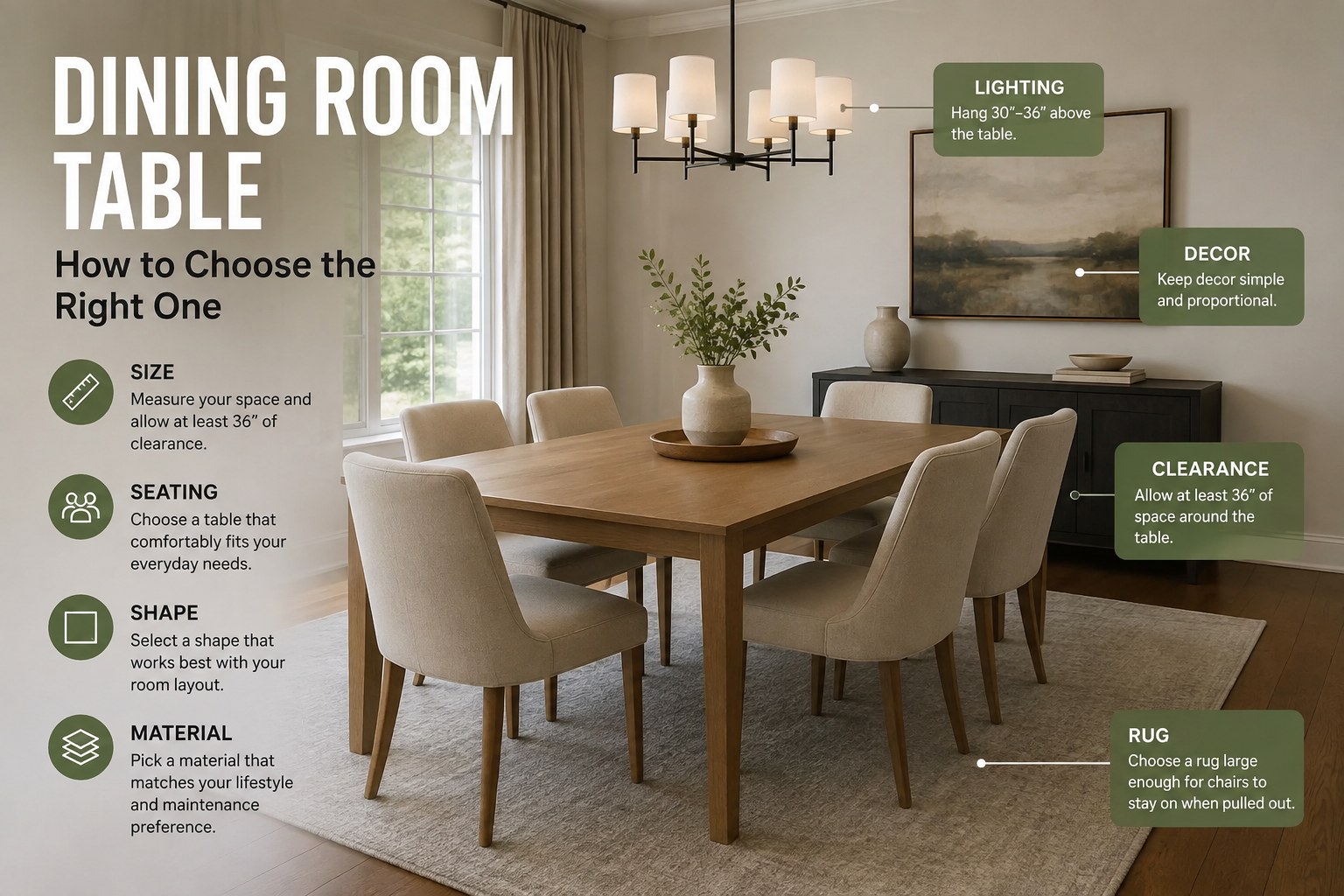
A dining room table is more than a place to eat. It often becomes the center of family meals, weekend gatherings, homework sessions, celebrations, and everyday conversations. Because of that, choosing the right dining room table requires more thought than simply picking a style you like.
The best table should fit your room comfortably, provide enough seating, complement your dining chairs, and suit the way you actually live. Size, shape, material, table height, leg placement, and maintenance can all affect whether a table feels practical or becomes an obstacle.
Whether you’re furnishing a compact apartment, updating a formal dining room, or looking for a table that can handle frequent entertaining, this guide explains how to choose a dining room table that balances style and function.
How to Choose the Right Dining Room Table
Before comparing finishes or furniture styles, start with the practical details. A beautiful table will not work well if it overwhelms the room or leaves no space for chairs and foot traffic.
1. Measure Your Dining Space
Measure the length and width of the area where the table will sit. Don’t forget fixed features such as walls, doors, windows, cabinets, radiators, and sideboards.
You also need room for people to pull chairs away from the table and walk behind them. A useful planning guideline is to allow roughly 36 inches of clearance around a dining table where possible.
For example, a large rectangular table may technically fit inside a room but still make the space uncomfortable if chairs block the main walkway.
2. Decide How Many People You Need to Seat
Think about everyday use rather than occasional events.
A household of four doesn’t necessarily need a permanent eight-seat table. If you regularly host guests, an extendable dining room table may provide a better balance between everyday comfort and entertaining capacity.
3. Choose a Shape
The shape should work with the room’s geometry.
A rectangular table is often suitable for long rooms, while a round table can make a compact or square room easier to navigate. Oval tables offer some of the capacity of rectangular designs while creating softer visual lines.
4. Choose a Material
Your lifestyle should influence the material. A family with young children may prioritize an easy-care surface, while someone furnishing a formal dining room may place greater emphasis on natural stone or handcrafted wood.
5. Consider Long-Term Use
Ask how the table will be used five years from now.
Will it host family dinners every night? Will someone work from it during the day? Will you regularly entertain large groups? These questions can be more important than current decorating trends.
Dining Room Table Size Guide
Getting the dimensions right is one of the most important parts of choosing a dining room table.
As a general planning guide, allow approximately 24 inches of table edge per person. Actual capacity can vary depending on the table’s shape, leg placement, chair width, and desired personal space.
| Seating | Typical Table Options | Best For |
| 2 people | Small round or square | Apartments and breakfast areas |
| 4 people | 36–48-inch round or compact rectangle | Small households |
| 6 people | 60–72-inch rectangle or suitable round/oval | Family dining |
| 8 people | 72–96-inch rectangle or oval | Larger families |
| 10+ people | 96-inch+ or extendable table | Frequent entertaining |
These measurements are starting points rather than strict rules. A table with a bulky base may accommodate fewer chairs than a similarly sized table with a central pedestal.
What Is the Standard Dining Table Height?
Most conventional dining tables are around 28 to 30 inches high. The important consideration is the relationship between the table and chairs.
A chair should provide enough legroom for comfortable dining without forcing your knees against the tabletop or apron. When shopping, consider both seat height and the thickness of the table structure underneath the surface.
How Much Space Should Be Around a Dining Table?
Aim for approximately 36 inches of usable clearance around the table when the layout allows it. This gives people space to pull out chairs and move around the dining area.
If the table sits next to a wall, you may need to plan differently. In a high-traffic open-plan room, more clearance may be desirable.
Which Dining Table Shape Is Best?
There isn’t one universally best dining table shape. The right choice depends on your room and how you use it.
Rectangular Dining Table
Rectangular tables are among the most versatile choices. Their long shape works particularly well in elongated dining rooms and can provide substantial seating without taking up unnecessary width.
They’re also convenient for larger families and entertaining. Many extendable tables use a rectangular design, allowing the surface to grow when guests arrive.
Round Dining Table
A round dining table can be an excellent choice for smaller or square rooms.
Because it has no corners, it can improve circulation and create a more intimate dining experience. Everyone can generally see and speak with one another easily.
Round tables also pair particularly well with pedestal bases because the absence of four corner legs creates more flexible chair placement.
Oval Dining Table
An oval table combines characteristics of rectangular and round designs.
It can provide generous seating while reducing the visual hardness of sharp corners. This makes an oval dining table appealing in rooms where you want capacity without a heavily angular appearance.
Square Dining Table
Square tables work naturally in square rooms and can be practical for two or four people.
However, very large square tables may make conversation and serving less convenient because people are farther apart. They’re generally most effective when their proportions match the size of the room.
Curved and Sculptural Tables
Curved dining tables can act as a design statement. They’re particularly suitable for contemporary interiors where furniture is expected to contribute significantly to the overall aesthetic.
Because unusual shapes can be harder to position, measure the room carefully before choosing one.
Best Dining Room Tables for Small Spaces
Small dining areas require careful planning. Instead of automatically choosing the smallest possible table, look for furniture that makes efficient use of the available space.
Choose a Round Table
A compact round dining room table can eliminate awkward corners and make it easier to move around a small room.
Consider an Extendable Table
An extendable table can remain compact for everyday meals and expand when you have guests.
For example, a household of four could use a six-seat table most days and extend it for holiday dinners rather than permanently occupying valuable floor space with a much larger table.
Look for a Pedestal Base
A pedestal can provide greater flexibility for chair placement because there aren’t four separate legs competing for legroom.
Don’t Forget the Chairs
A compact table can still feel oversized if paired with very wide dining chairs. Measure the chair width and armrests as well as the tabletop.
Dining Table Materials Compared
The best dining table material depends on your priorities for appearance, durability, maintenance, and budget.
| Material | Appearance | Maintenance | Best For |
| Solid wood | Warm and natural | Moderate | Everyday family use |
| Wood veneer | Consistent wood look | Low to moderate | Practical interiors |
| Glass | Light and contemporary | Frequent cleaning | Modern spaces |
| Marble/stone | Luxurious and distinctive | Moderate to high | Statement dining rooms |
| Ceramic/engineered surfaces | Modern and practical | Often easy | Busy households |
| Metal/mixed materials | Contemporary or industrial | Varies | Modern interiors |
Solid Wood
Solid wood is a popular choice because it offers warmth, character, and the possibility of repair or refinishing depending on its construction and finish.
Natural variations in grain and color can also make every table visually distinctive.
Glass
Glass can make a small dining room feel visually lighter because the tabletop doesn’t create as much visual mass.
The trade-off is that fingerprints, smudges, and spills can be more noticeable.
Marble and Stone
Stone creates a luxurious focal point and can work beautifully in formal or contemporary interiors.
However, different stone types and finishes have different care requirements. Always follow the manufacturer’s cleaning and sealing recommendations.
Ceramic and Engineered Surfaces
These materials can provide a contemporary appearance with practical characteristics, but performance varies by product. Check the manufacturer’s specifications before assuming a surface is completely stain-, scratch-, or heat-proof.
Choose a Dining Table for Your Lifestyle
For Families With Children
Prioritize durability and easy maintenance. Rounded corners may also be preferable in busy households.
For Frequent Entertaining
Consider an extendable rectangular or oval dining room table. This gives you flexibility without requiring a permanently oversized table.
For Apartment Living
Look for compact dimensions, round shapes, pedestal bases, or extension mechanisms.
For Work-From-Home Households
If the table doubles as a workstation, consider surface depth, comfortable legroom, and a finish that can tolerate frequent daily use.
How to Choose the Right Dining Table Base
The base affects both appearance and comfort.
Four-Leg Base
A traditional four-leg design is stable and versatile, but the legs can interfere with chairs depending on their position.
Pedestal Base
A pedestal can improve legroom and chair placement. It is especially useful with round tables.
Trestle Base
Trestle designs can give larger tables a distinctive traditional or farmhouse appearance. Check where the supports sit before deciding how many chairs will fit comfortably.
Sculptural Base
Contemporary tables may use a central or artistic base. These can create a strong visual focal point but should still provide practical legroom.
How to Match a Dining Table With Chairs
Your dining table and chairs don’t necessarily have to be an identical set.
Focus on proportion first.
Check:
- Chair seat height
- Chair width
- Armrest height
- Table height
- Leg placement
- Available space between chairs
For example, six narrow side chairs may fit comfortably around a table where six oversized armchairs would feel cramped.
Mixing materials can also create a more personalized look. A simple wooden dining table can work with upholstered, metal, woven, or contemporary chairs when their proportions and finishes complement one another.
How to Style a Dining Room Table
A dining room table should work with the rest of the room rather than exist as an isolated piece.
Add the Right Rug
Choose a rug large enough that dining chairs remain on the rug when pulled away from the table. An undersized rug can make the furniture arrangement look disconnected and may cause chair legs to catch on the rug edge.
Choose Appropriate Lighting
A rectangular table often works well beneath a linear pendant or chandelier, while a round table can pair naturally with a centered fixture.
The lighting should illuminate the dining area without obstructing views across the table.
Keep Centerpieces Practical
A low vase, bowl, candle arrangement, or seasonal centerpiece can add personality without making conversation difficult.
For everyday dining, simplicity is usually more functional than an oversized decorative arrangement.
Are Extendable Dining Tables Worth It?
For many households, yes.
An extendable dining table can solve a common problem: needing a small footprint most days but additional seating several times a year.
Before buying one, inspect how the extension mechanism operates, whether the leaves store inside or separately, and whether the extended surface remains stable.
If you regularly host eight people but usually dine with four, an extension table may be more practical than purchasing a permanently large table.
Common Dining Room Table Buying Mistakes
Avoid these common problems:
- Buying based only on appearance: A beautiful table still needs to fit your room.
- Ignoring chair clearance: Measure the usable space around the table.
- Choosing the wrong shape: Match the table to the room’s geometry.
- Forgetting the table base: Legs and supports can affect seating capacity.
- Buying too much table: Extra seating isn’t useful if it makes everyday circulation difficult.
- Ignoring maintenance: Choose a surface that matches your lifestyle.
- Forgetting delivery access: Measure doorways, stairs, elevators, and tight turns.
- Choosing the wrong rug size: Dining chairs need enough room to move naturally.
- Ignoring future needs: Consider whether your household or entertaining habits may change.
How to Care for Your Dining Room Table
Care depends on the material and finish.
Use coasters and placemats where appropriate, clean spills promptly, and avoid harsh products unless the manufacturer specifically recommends them.
Wood may require particular attention to moisture and heat. Glass benefits from regular cleaning, while stone surfaces can have specific sealing and cleaning requirements.
Most importantly, follow the care instructions supplied by the manufacturer. Two tables made from the same broad material can have very different finishes and maintenance requirements.
A Simple Dining Table Buying Checklist
Before purchasing a dining room table, confirm:
- The table fits the room
- There is sufficient chair and walking clearance
- The seating capacity meets your everyday needs
- The shape suits the room
- The material matches your lifestyle
- The table height works with your chairs
- The base doesn’t interfere with seating
- Delivery access has been checked
- The table works with your rug and lighting
- Maintenance requirements are realistic
- The price fits your budget
Conclusion
The best dining room table isn’t necessarily the biggest, most expensive, or most fashionable option. It’s the one that fits your space, supports your everyday routine, and complements the way you entertain.
Start by measuring the room and determining your real seating needs. Then compare shapes, materials, table bases, and maintenance requirements. If space is limited, consider a round, pedestal, drop-leaf, or extendable design. If entertaining is a priority, choose a table that gives you flexibility without overwhelming the room every day.
When you combine practical measurements with thoughtful design, your dining room table can become a comfortable, durable centerpiece that works for both everyday meals and special occasions.
Frequently Asked Questions
What is the best shape for a dining room table?
The best shape depends on your room. Round tables are often effective in small or square spaces, while rectangular tables work well in longer rooms and provide efficient seating for larger households.
What size dining table should I get for six people?
A rectangular table around 60 to 72 inches can often accommodate six people, but the ideal size depends on chair width, table-leg placement, and how much personal space you prefer.
How much space should be around a dining table?
Approximately 36 inches of clearance around the table is a useful planning guideline. High-traffic areas may benefit from additional space.
Is a round or rectangular dining table better for a small room?
A round table can be particularly effective in a small room because it eliminates corners and can improve circulation. A compact rectangular table may be better when you need to maximize seating along a narrow wall.
What is the standard height of a dining table?
Most conventional dining tables are approximately 28 to 30 inches high. Always compare the table height with your dining chair dimensions to ensure comfortable legroom.
Are extendable dining tables worth it?
They can be an excellent choice for households that need compact everyday seating but occasionally host larger groups. They’re especially useful in apartments and multifunctional dining spaces.
What is the most durable dining table material?
There isn’t one universal winner. Durability depends on the material, construction, finish, and use. Solid wood can be highly practical for everyday use, while other engineered or ceramic surfaces may suit households prioritizing easy maintenance.